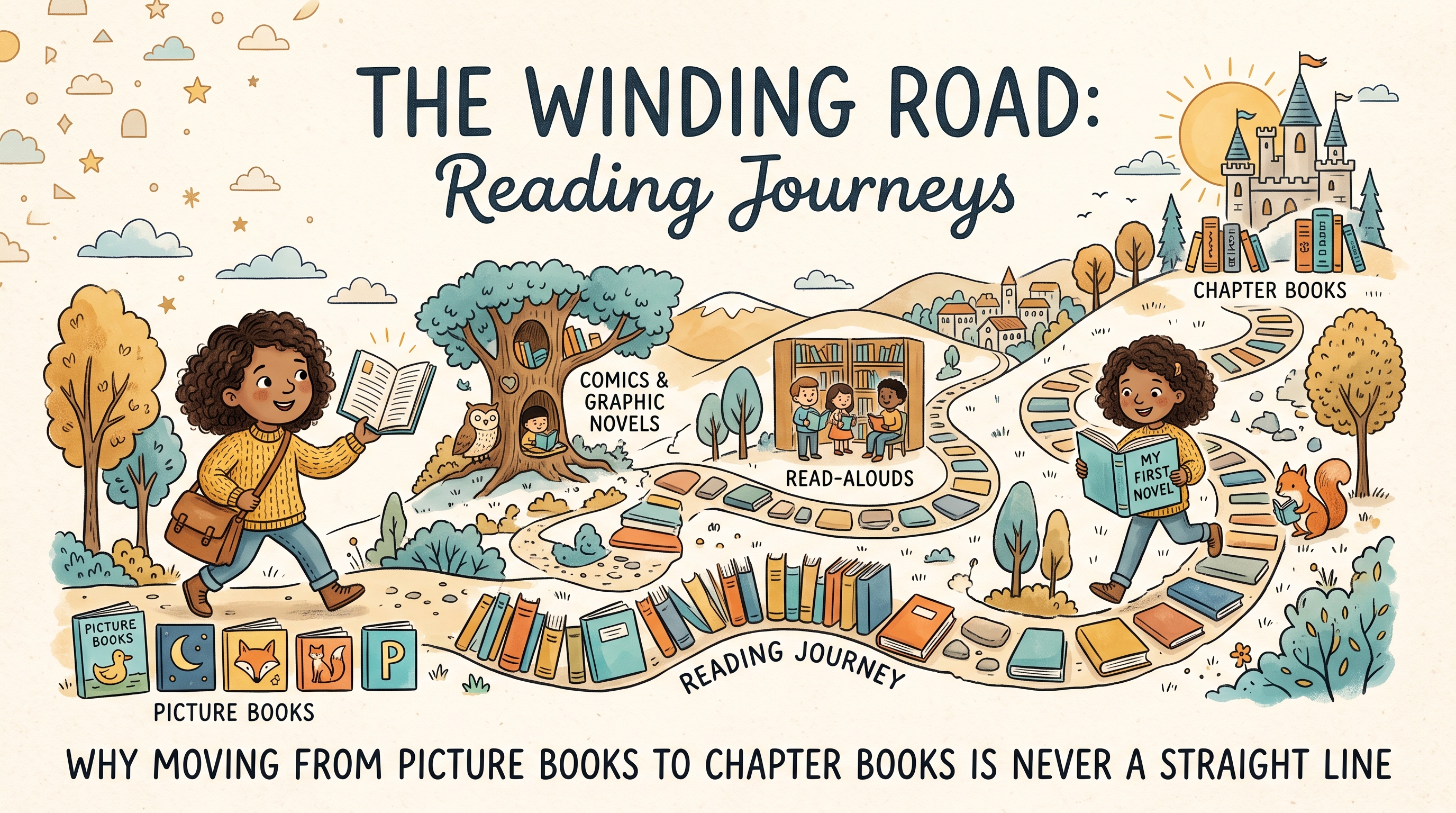
Literacy researchers at Ohio State University observed second-grade classrooms over an academic year and documented that children capable of reading early chapter books routinely chose illustrated titles during free reading time. This behavior often surprises parents who view reading development as a strict ladder—a progression from board books to picture books, then to early readers, and finally to unillustrated chapter books. When a seven-year-old who finished their first chapter book picks up a thirty-two-page picture book the next evening, adults often worry that the child is taking a step backward.
That assumption misinterprets how reading comprehension actually develops between ages six and eight. Moving between illustrated pages and text-dense chapters is not a sign of retreat. It is a sign of a reader managing their own cognitive energy while expanding how they process narrative.
The Cognitive Load of the Unillustrated Page
Reading a page of prose requires two distinct mental operations running simultaneously: decoding symbols into words and constructing a mental scene from those words. In picture books, the illustrator supplies the visual background, spatial relationships, and character expressions. This allows the child’s brain to dedicate its working memory entirely to sentence flow, word sound, and emotional tone.
When a child opens an early chapter book with few or no illustrations, the visual scaffolding vanishes. The child must now build the room, the weather, the movement, and the physical appearance of the characters out of text alone. For an emerging reader, this dramatic shift in cognitive load creates fatigue.
Returning to a picture book after finishing a chapter book is a functional reset. It allows the brain to experience story, character, and pacing without the constant demand of visual fabrication. Children who are allowed to alternate between formats stay at the reading table longer because they can regulate their own mental stamina.
Picture Books Contain More Complex Words
A common misconception is that chapter books always feature more advanced language than picture books. In reality, early chapter books are engineered around controlled vocabularies, short sentence structures, and predictable sight words designed to build decoding speed.
Picture books, meant originally for shared reading between adults and children, operate under no such constraints. Authors writing thirty-two-page picture books frequently use precise, rare, and evocative vocabulary—words like sombre, luminescent, cascade, or iridescent—because the accompanying illustration gives the child an immediate context clue. A second-grader reading a picture book often encounters richer sentence variety and sophisticated word choice than they will find in a level-one chapter reader.
By keeping picture books in the rotation, young readers continue to build their oral vocabulary and ear for rhythm even as their eyes learn to scan longer blocks of text in chapter books.
The Power of Visual Narrative Construction
Visual literacy is not a stepping stone that a child outgrows; it is a permanent dimension of reading. Graphic novels, illustrated middle-grade novels, and world-building story environments demonstrate that images do not replace text—they interact with it.
In complex illustrated works, the art often tells part of the story that the prose leaves unsaid. A character may speak bravely in the text while the illustration reveals them hiding something behind their back. Interpreting this gap requires high-level inference, irony detection, and critical thinking—skills that are harder to cultivate in plain text alone at age seven. When children create or explore stories in environments like Inky, where written lore, visual illustration, and narration exist side by side, they learn that a story grows richer when visual and textual layers build on each other.
When parents treat chapter books as a final destination and restrict picture books, children begin to view reading as an endurance test rather than an immersive experience. Total reading volume drops when reading feels like work.
Supporting the Non-Linear Reader
Supporting a reader between ages six and eight requires treating all formats as equally valid tools for story engagement.
- Keep picture books, graphic novels, and early chapter books on the same accessible shelf without separating them by difficulty level.
- Allow children to re-read familiar picture books alongside new chapter series to maintain emotional confidence.
- Read early chapter books aloud together while letting the child hold and read an illustrated book independently during quiet time.
Children who are free to move back and forth between picture books and chapter books develop greater reading flexibility, stronger vocabulary retention, and higher voluntary reading volume than those who are pushed across an artificial finish line.
Newsletter
A little more wonder, weekly.
Story ideas, parenting reads, and what we’re building next.
Like this? There's one more next week
Free weekly note on using stories to navigate the things parenting books skip.
No spam. Just story inspiration and new feature updates.
Written by
Founder, Inky
Building Inky — an AI storytelling studio for personalized, imaginative stories. Writing about raising readers and creativity.


