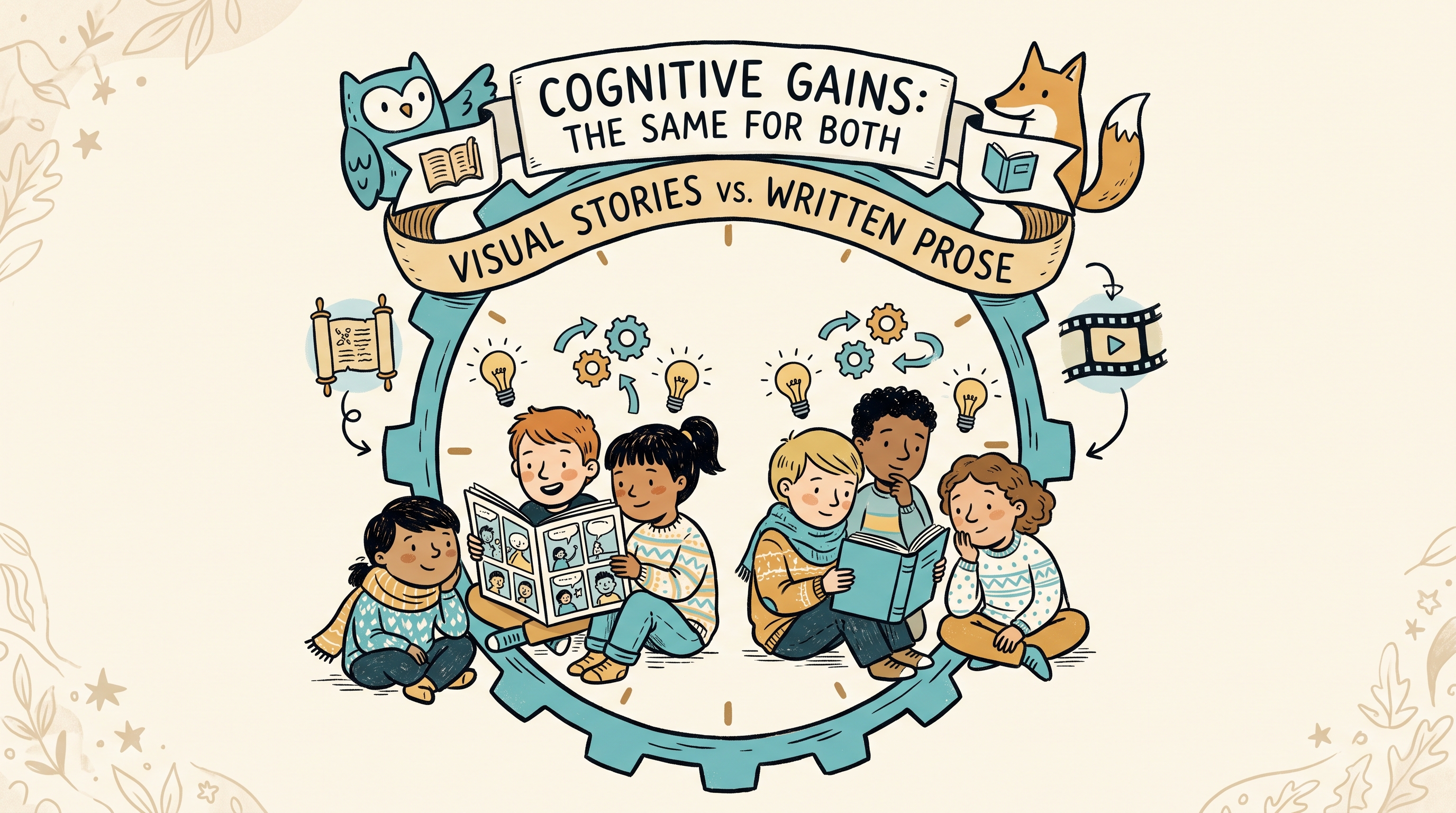
In 1988, researchers D.P. Hayes and M.G. Ahrens analyzed the vocabulary density of popular media and found that comic books contained 53.5 rare words per thousand words, higher than the 30.9 found in traditional children's fiction.
The long-standing myth that illustrated storytelling relies on simplified language dissolves when measured against how words are actually used on the page. Because visual panels handle setting, mood, and spatial layout, text space is freed from describing every physical object. This allows dialogue and narrative captions to deploy precise, expressive vocabulary that might otherwise overwhelm a young reader in dense block prose. Words like subterranean, impenetrable, or treacherous appear naturally in visual stories because the artwork supplies instant structural context. A reader encounters complex language without losing the thread of the plot.
Visual Context and Contextual Vocabulary
When a reader stumbles over an unfamiliar word in traditional prose, their options are limited: look it up, attempt to deduce its meaning from surrounding sentences, or skip it entirely. Skip too many words, and comprehension collapses.
In a graphic novel, visual panels act as immediate scaffolded context. If a character peers into a cavern and the caption describes the passage as labyrinthine, the illustration of intersecting, twisting stone tunnels anchors the term. The reader absorbs the definition organically while maintaining reading momentum. This pairing of visual clarity and sophisticated vocabulary accelerates language acquisition, allowing readers to absorb higher-tier vocabulary earlier in their reading development.
Dual-Coding and Cognitive Synthesis
Cognitive psychologists explain this phenomenon through dual-coding theory, which describes how the human brain processes verbal and visual information simultaneously. Far from being a shortcut, reading a panel-based page requires multi-layered cognitive synthesis. The brain must process textual dialogue, evaluate facial expressions, assess spatial movement across panels, and interpret color choices or line density—all in real time.
Between each panel lies the "gutter," the blank space that separates one moment from the next. The gutter requires a specific form of critical thinking known as closure. When panel A shows a lighthouse keeper gazing at an approaching storm and panel B shows a cracked lantern on a dark beach, the narrative does not state what occurred in the interval. The reader must infer the missing action. This active inference is the exact cognitive skill required to analyze complex, unillustrated literary fiction.
Stamina, Volume, and Print Fatigue
For many developing readers, the primary barrier to long-form reading is print fatigue. Pages filled entirely with text demand intense visual tracking, and for children still refining those eye movements, the physical mechanics of reading can consume the energy needed for story comprehension.
Illustrated narrative structures mitigate this mechanical hurdle. The variation between wide environmental shots, close-up character reactions, and brief textual captions gives the eye natural resting points without pausing the narrative. A child reading a three-hundred-page graphic novel is digesting thousands of words, following multi-strand plotlines, and sustaining attention across several hours. The stamina built during this extended engagement is genuine literary stamina. The habit of staying inside a complex story across days or weeks transfers directly across formats.
Canon Tracking and Narrative Architecture
The world-building found in serialized graphic novels often rivals or exceeds the complexity of traditional prose sagas. Readers must track persistent world rules, sprawling cast rosters, geographical layouts, and overlapping character backstories across dozens of installments.
In these story worlds, details are rarely decorative; they form a visual canon. An insignia sewn onto a coat sleeve, a subtle shift in map topography, or a recurring background character can foreshadow major plot movements or reveal hidden motives. Readers learn to scan the whole page, developing sharp observational habits and learning to synthesize subtle visual clues with main-text narrative beats.
Lasting Literacy
Categorizing visual storytelling as a temporary step toward "real" books mistakes the medium for a compromise. The cognitive processes involved—deductive inference, rapid vocabulary integration, spatial tracking, and visual-textual synthesis—are permanent additions to a reader's mental toolkit.
When young readers are granted full access to illustrated narratives, they read more total pages, encounter a broader spectrum of advanced vocabulary, and build the confidence necessary to engage with complex narrative worlds wherever they find them.
Newsletter
A little more wonder, weekly.
Story ideas, parenting reads, and what we’re building next.
Like this? There's one more next week
Free weekly note on using stories to navigate the things parenting books skip.
No spam. Just story inspiration and new feature updates.
Written by
Founder, Inky
Building Inky — an AI storytelling studio for personalized, imaginative stories. Writing about raising readers and creativity.

