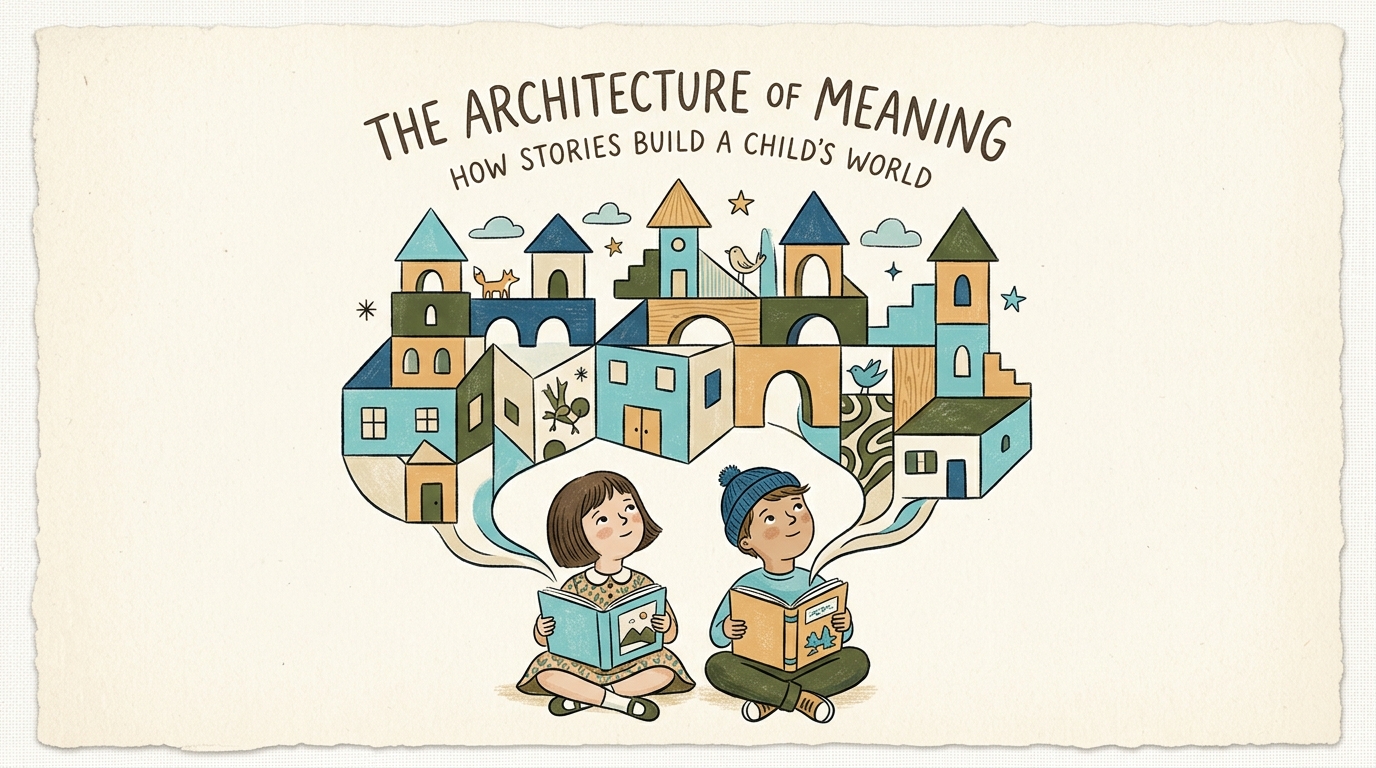
In 1995, Betty Hart and Todd Risley published a study showing that children who grew up in talkative households heard 30 million more words by their fourth birthday than children who did not. This research, often cited as the "word gap," highlighted a stark reality: the volume of language a child encounters early in life creates the foundation for every intellectual pursuit that follows. However, vocabulary development is not merely a matter of counting nouns and verbs. It is about the quality of the encounters a child has with language and how those words are anchored to meaning within a living context.
The Anchor of Context
A word encountered in isolation is a ghost; it lacks weight and presence. When a child learns the word "perched" from a list, it remains a fragile concept. When that same child reads about a dragon perched atop a jagged mountain peak, the word acquires texture, height, and a sense of precariousness. This is the power of a story-world. Narrative provides the soil in which a new word can take root.
In stories, words are rarely static. They are used to describe the stakes of a character's journey or the specific details of a landscape. This contextual learning allows children to infer meaning, a skill that serves them far better than rote memorization. When a reader understands a word through the surrounding action, they are not just learning a definition; they are witnessing the word in motion. This creates a mental map where ideas become worlds, allowing the brain to store language in a way that is easily retrievable because it is attached to an emotion or a vivid image.
Moving Beyond the Everyday
Conversational language, while essential, is often limited to what educators call "Tier 1" words—the high-frequency terms used in daily life, such as "eat," "happy," or "table." To grow their understanding, children must be exposed to "Tier 2" words. These are sophisticated terms like "resilient," "absurd," or "meticulous." These words rarely appear in casual dinner table conversation, but they are the lifeblood of literature.
Reading accelerates vocabulary because authors use these Tier 2 words to provide precision. A character isn't just "sad"; they might be "melancholy" or "dejected." By encountering these nuances within a series or a recurring world, a child sees the same word used across different scenarios. This repetition is the key to mastery. It takes approximately twelve to fifteen meaningful encounters with a word for it to enter a child’s permanent expressive vocabulary. A story-world that grows over several volumes provides the perfect environment for this natural reinforcement.
The Illustrated Bridge
For many readers, particularly those in the early stages of development or those learning a new language, the bridge between a sound and a concept is a visual one. Illustrations do not just decorate a page; they provide a secondary layer of evidence for what a word means. If a story describes a "luminous" forest, and the artwork shows trees glowing with a soft, ethereal light, the child makes an immediate and permanent connection.
This multisensory approach is especially effective for abstract concepts. Words like "courage" or "betrayal" are difficult to define with a simple picture, but they can be illustrated through the posture of a character or the shifting colors of a scene. When a world is fully realized through both text and art, the reader is not struggling to decode symbols in a vacuum. They are inhabiting a space where the language is a natural extension of the environment. This reduces the cognitive load of reading, allowing the brain to focus on the joy of the story while subconsciously cataloging new vocabulary.
From Reader to World-Builder
The final stage of vocabulary development occurs when a child moves from consuming a story to creating one. When an author-in-training decides to spin off a universe they have grown to love, they begin to reach for the specific words that defined that world. They use the canon as a vocabulary bank. This transition from passive recognition to active use is the "Matthew Effect" in reading—a term coined by Keith Stanovich to describe how early success in acquiring language leads to further success, creating a compounding cycle of growth.
Inky provides a space where this transition happens naturally, as builders use the vocabulary of established worlds to narrate their own new chapters. When a child writes a story about a "treacherous" sea because they read about one in a community world, they have moved beyond being a student of language. They have become a practitioner of it. They are no longer just learning words; they are using them to build architectures of meaning that others can explore.
The depth of a child's vocabulary ultimately determines the resolution of their world. A limited vocabulary results in a world seen in low definition, where complex emotions and intricate ideas are blurred. A rich vocabulary provides the tools to see the world—and the worlds of others—with clarity and precision. The more words a child owns, the more territory they can claim in the landscape of human thought.
Newsletter
A little more wonder, weekly.
Story ideas, parenting reads, and what we’re building next.
Like this? There's one more next week
Free weekly note on using stories to navigate the things parenting books skip.
No spam. Just story inspiration and new feature updates.
Written by
Founder, Inky
Building Inky — an AI storytelling studio for personalized, imaginative stories. Writing about raising readers and creativity.