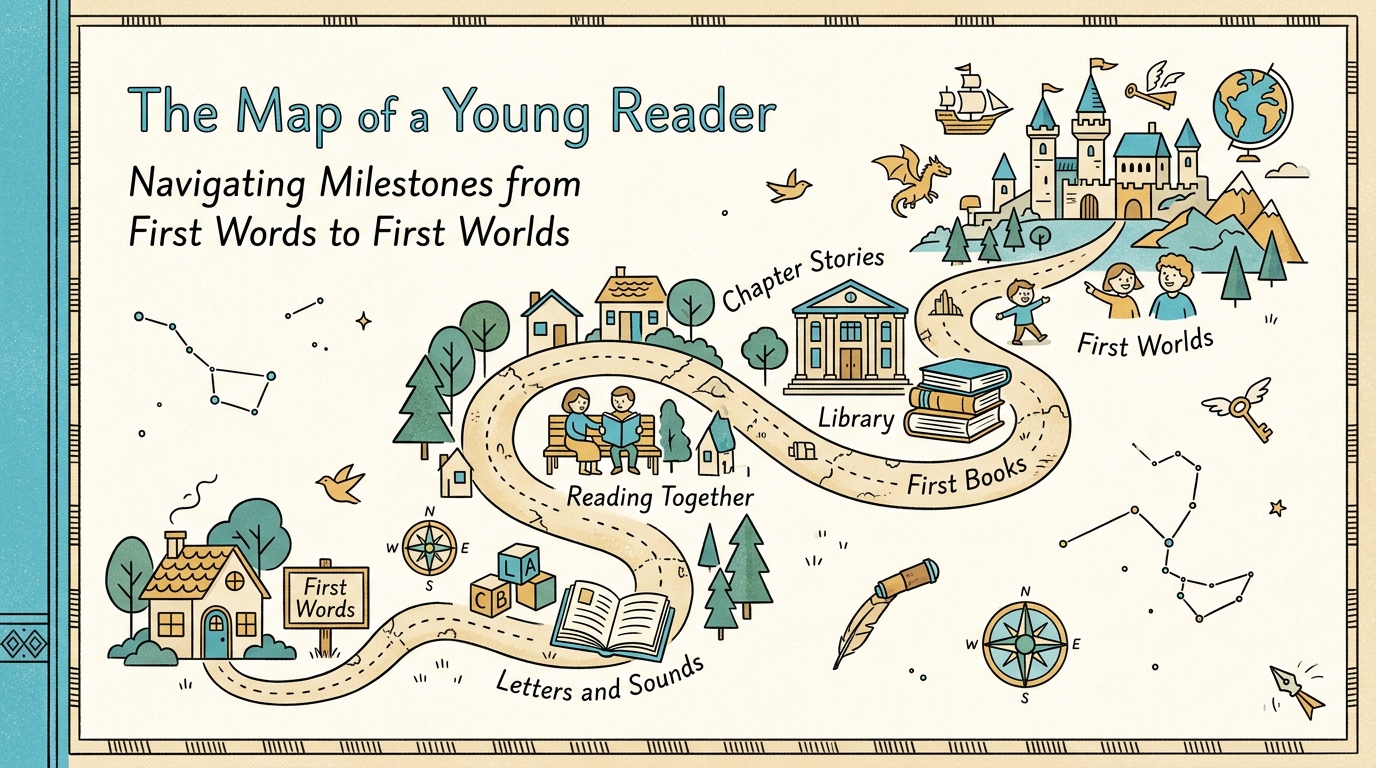
At the New York Public Library, children's librarians often observe that the age of 7 represents the most significant leap in a child’s journey toward independent storytelling. This is the moment when the mechanics of language begin to recede into the background, allowing the landscape of the story to take the foreground. Before this transition, a book is often an object to be decoded; afterward, it becomes a space to be inhabited. Understanding these milestones helps authors and parents alike provide the right map for a growing mind, ensuring that the spark of curiosity never flickers out under the weight of a text that is too dense or a story that is too thin.
The Emergent Reader (Ages 0 to 5)
In these early years, the goal is not the recognition of sentences but the cultivation of narrative logic. An idea is a seed planted during the thousands of hours a child spends listening to the cadence of a caregiver’s voice. Between birth and age 3, milestones are sensory. A child learns that a book has a "right side up," that pages turn from right to left, and that the black marks on the page stay the same every time the story is told. They are learning the rhythm of their native tongue—the phonemes that make up the building blocks of every future world they will visit.
By age 4 or 5, the focus shifts to phonological awareness. This is the ability to hear and play with the individual sounds in words. A child at this stage might recognize that "cat" and "hat" share a sound, or that their own name starts with the same letter as the grocery store sign. They begin to understand that stories have a beginning, a middle, and an end. They aren't just hearing words; they are beginning to predict what happens next, a fundamental skill for any future world-builder.
The Early Reader (Ages 5 to 7)
This window is often characterized by the "great decoding." In many school systems, children are introduced to the Dolch List—a collection of 220 high-frequency words that constitute the majority of the text in children’s books. These "sight words," such as the, and, and there, must be recognized instantly so the reader can save their mental energy for more complex vocabulary.
At this stage, the child is moving from "learning to read" to "reading to learn." They begin to master the relationship between graphemes (letters) and phonemes (sounds). The milestone here is fluency: the ability to read a sentence with the same expression and pace as natural speech. When a child can read a page without stopping to sound out every third word, the door to the imagination swings wide open. They are no longer looking at the map; they are starting to walk the trail.
The Transitional Reader (Ages 7 to 9)
Once fluency is established, the reader enters the era of the "chapter book." This transition is less about the difficulty of the words and more about the stamina of the mind. In a picture book, the art does the heavy lifting of world-building. In a chapter book, the author provides the blueprints, but the reader must build the world inside their own head.
Milestones in this bracket include the ability to remember plot points across multiple sittings and the development of "inferencing" skills—understanding what a character is feeling even if the author doesn't explicitly state it. This is the age where readers become deeply attached to series. They aren't just reading a book; they are entering a canon. They want to know what happens to the same group of friends in five different scenarios because they have begun to treat those characters as living entities with their own history and consistency.
The Independent Navigator (Ages 9 to 12)
By age 9, the reading experience becomes deeply personal. Readers at this stage begin to seek out specific genres that mirror their own interests or provide an escape from their daily lives. They are capable of handling multiple subplots and complex themes like justice, sacrifice, and the nuances of right and wrong.
The milestone here is the shift from consumer to participant. A reader who has spent years inhabiting the worlds of others often feels the urge to start sketching the borders of their own. They might write fan fiction, draw maps of imaginary lands, or debate the "rules" of a magic system with their peers. This is where ideas become worlds. A child might spend an afternoon reading about a deep-sea explorer and the next three days detailing the biology of the creatures that live in that explorer’s ocean. On Inky, this is the stage where the distinction between reader and author begins to blur, as the community library offers a space to not just witness a story, but to grow the universe surrounding it.
The Lifelong Builder (Ages 12 and Up)
In the teen years and beyond, reading milestones are no longer about capability, but about perspective. An adolescent reader uses stories to stress-test their own identity. They look for "mirror" stories that reflect their own experiences and "window" stories that offer a view into lives completely unlike their own.
The final milestone in a reader’s development is the realization that no story is ever truly finished. A world with a rich enough canon and a strong enough soul can support infinite offshoots. Whether it is a parent building a custom bedtime universe for a toddler or a teenager spinning off a favorite sci-fi series, the journey of the reader eventually circles back to the beginning. The person who once sat listening to the rhythm of a voice now uses their own voice to build something new for the next generation. The most enduring stories are those that give the reader the tools to become an author.
Newsletter
A little more wonder, weekly.
Story ideas, parenting reads, and what we’re building next.
Like this? There's one more next week
Free weekly note on using stories to navigate the things parenting books skip.
No spam. Just story inspiration and new feature updates.
Written by
Founder, Inky
Building Inky — an AI storytelling studio for personalized, imaginative stories. Writing about raising readers and creativity.