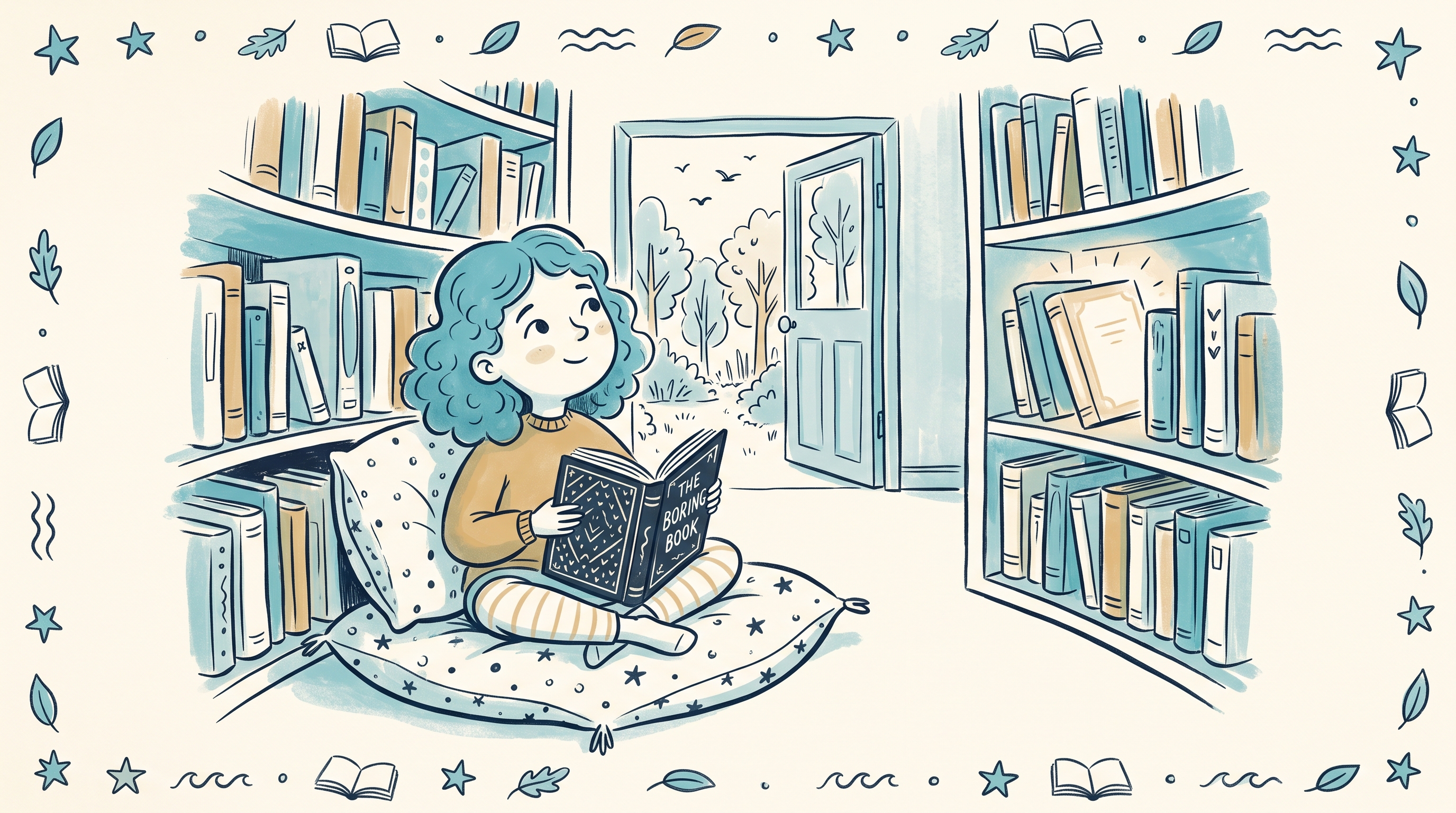
Nancy Pearl, the Seattle librarian who established the "Rule of 50" for adults, declared that readers owe a book fifty pages before earning the right to put it down forever. For anyone over fifty years old, Pearl's adjusted rule is even simpler: subtract your age from one hundred, and that is your page limit, because life is far too short to read books that fail to engage. Yet when a seven-year-old pushes aside a novel on page twelve, adults often respond with anxiety, treating a dropped book as a failed assignment rather than a healthy exercise in personal taste.
We rarely hold grown readers to this rigid standard. If a mystery novel loses its momentum by chapter three, an adult simply sets it on the nightstand and reaches for a biography. For a child, however, putting down an uninspiring story is frequently misdiagnosed as a short attention span or an aversion to reading itself. Most children who are labeled reluctant readers do not dislike stories; they dislike the specific story currently sitting in front of them, combined with the pressure that they must suffer through to the final page.
The Sunk Cost of the Unfinished Chapter
When a child is compelled to finish every book they open, the act of turning a cover transforms from an invitation into a debt. The mental calculation changes entirely. Instead of wondering what lies past the next turn of the page, the child counts how many pages remain until they are finally freed from the chore.
This obligation creates an artificial ceiling on curiosity. A child who knows they are locked into every selection becomes deeply hesitant to try anything unfamiliar. They stick strictly to comfortable graphic novel series or familiar media tie-ins, not because they lack imagination, but because picking up a dense adventure story feels like signing an unbreakable contract. The fear of being stuck with a tedious narrative keeps them from taking creative risks on new characters, complex settings, or unfamiliar genres.
Scaling the Threshold to Young Minds
For a middle-grade reader, fifty pages is often half the entire book. The juvenile equivalent of Pearl’s standard is closer to twenty pages—or two short chapters in an illustrated reader. If an author has not built a clear bridge into the story by that mark, the reader has already learned enough to make a valid judgment.
Permission to stop reading is not permission to give up on books; it is the freedom to search for a better fit. When an adult explicitly tells a young reader that they can put a story back on the shelf after twenty pages if it fails to grab them, the entire psychological weight of the moment lifts. The decision to abandon an unengaging story becomes an act of literary taste rather than a behavioral failure.
Decoding Struggle Versus Disinterest
It is vital to distinguish between a child who cannot read the text and a child who simply does not care about the plot. Decoding fatigue—where the young brain works so hard to pronounce individual words that narrative meaning dissolves—requires targeted instructional support, simpler vocabulary, or shared reading aloud.
Disinterest looks entirely different. A child experiencing disinterest can decode the words easily, but their mind wanders because the world on the page offers no point of connection to their curiosity. A child fascinated by ocean cartography will drag their feet through a conventional school-yard story, not because the prose is too difficult, but because there are no ships, maps, or tides. Forcing that child to finish the friendship story does not turn them into a better reader; it simply delays the moment they discover a sea-faring adventure that would keep them reading under the covers with a flashlight.
Accelerating the Next Yes
The fastest way to get a child to say yes to a new book is to give them full authority to say no to the current one. When a young reader knows that walking away carries no penalty, no disappointment, and no lecture on perseverance, their willingness to sample new stories expands dramatically.
A child's reading shelf—whether made of paperbacks on a bedroom table, digital story-worlds in an app like Inky, or rows of public library loans—should function as a landscape to explore, not a checklist to complete. Readers who are trusted to abandon what bores them build something far more valuable than a list of completed titles: they build genuine taste, confidence in their own judgment, and a lifelong understanding that somewhere in the world, the right story is waiting for them.
When you reduce the cost of quitting a book that fails to spark wonder, you remove the primary barrier to finding the one that does.
Newsletter
A little more wonder, weekly.
Story ideas, parenting reads, and what we’re building next.
Like this? There's one more next week
Free weekly note on using stories to navigate the things parenting books skip.
No spam. Just story inspiration and new feature updates.
Written by
Founder, Inky
Building Inky — an AI storytelling studio for personalized, imaginative stories. Writing about raising readers and creativity.

