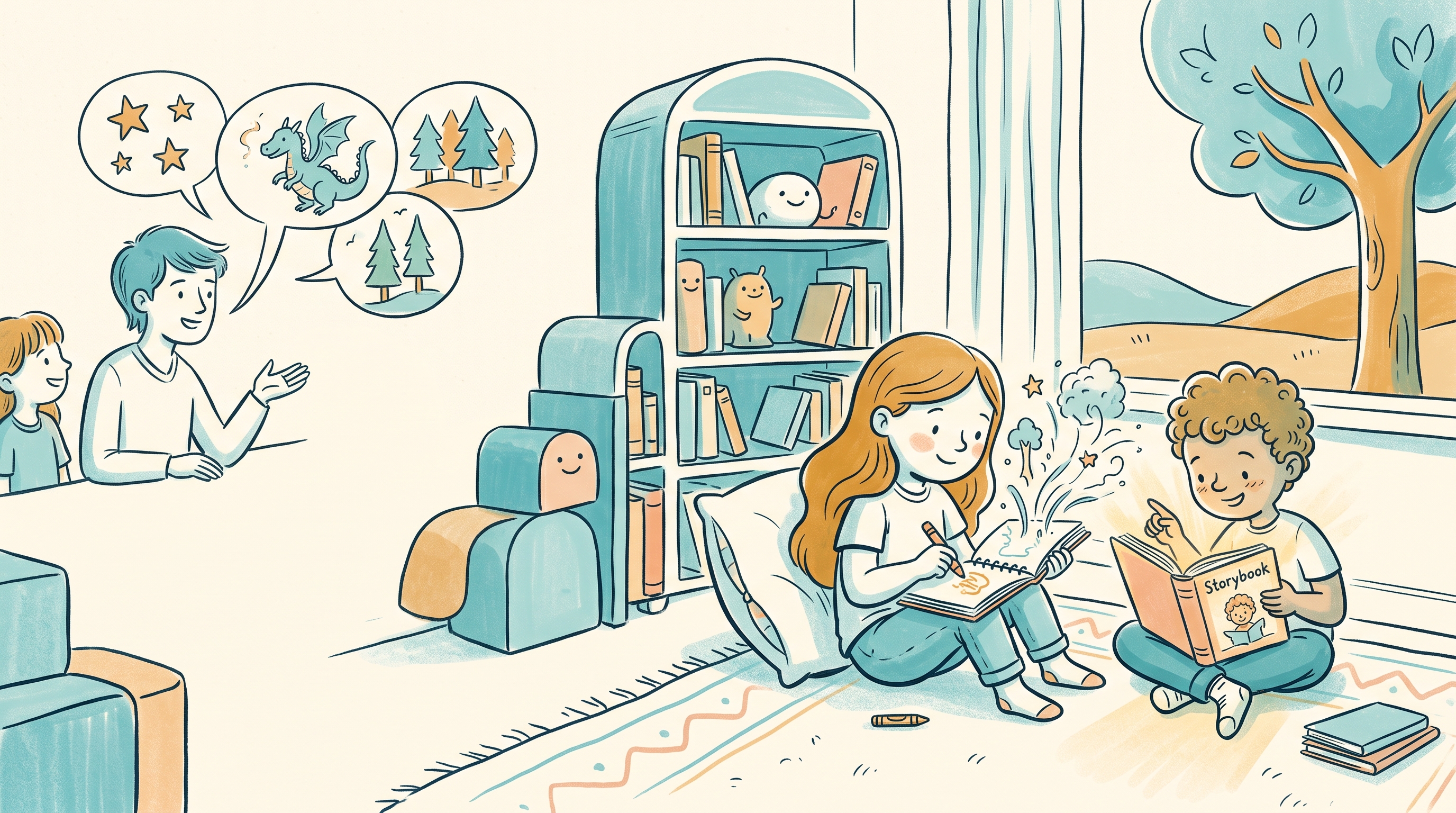
When a five-year-old child slides a picture book across the carpet and says "no," they are making a practical calculation about energy rather than a declaration about stories. Learning to decode printed text requires significant cognitive effort. For an early reader, sounding out words, tracking lines from left to right, and holding phonemes in memory demands working memory that adults take for granted. When the subject of that effort is a generic character in an unfamiliar setting, the effort feels unrewarded. The child experiences the book as an external assignment designed for someone else.
Resistance in early reading is rarely a lack of imagination. Children who reject books will often spend hours building intricate worlds out of plastic bricks, explaining the exact rules of a pretend kingdom to a stuffed animal, or narrating the dramatic rescue of a lost toy under the couch. The imagination is already fully active; it simply halts at the border of the printed page.
The Distance Between the Reader and the Page
Most early readers encounter books structured around universal archetypes. While classic stories offer broad appeal, they also require a child to make two cognitive leaps simultaneously: translating abstract shapes into words, and projecting themselves into a stranger’s reality.
For a confident reader, these leaps feel weightless. For a child who feels unsure of their skills, the distance between their own life and the page creates a psychological barrier. They watch adults read fluent sentences about unfamiliar children in distant towns, and they conclude that reading belongs to a world outside their own.
When adults attempt to solve this by forcing longer sitting sessions or offering external rewards, the resistance usually hardens. The book remains an object owned by the adult, pushed onto the child, carrying the implicit message that their own thoughts and language are secondary to the printed text.
Beyond the Name-Swap Novelty
Personalization has often been treated as a commercial novelty—a standard template where a single noun is swapped out so a child sees their name printed on a mug or a generic bedtime book. But genuine narrative alignment goes much deeper than inserting a name into an existing manuscript.
When a story reflects a child's actual environment—their specific fear of the dark corner behind the closet, the exact color of their boots, or the name of the neighbor's dog—the relationship to the text changes fundamentally. The child is no longer an audience member trying to peer into someone else’s house. They are the subject, the authority, and the guide.
Seeing their name embedded in a sentence changes how a child approaches decoding. A word like "Alexander" or "Maya" might be phonetically complex for a beginner, yet it is often the first word a child recognizes by sight. It carries personal weight. When that anchor word appears in a line of print, it acts as a landmark in an otherwise unfamiliar landscape. The child stops struggling through a sea of neutral symbols and begins navigating a familiar terrain.
Authority Drives Reading Motivation
Children crave agency. In a daily routine largely managed by adults, a story built around a child’s own decisions grants them immediate narrative authority.
When the main character shares their name and faces a dilemma rooted in their actual interests—whether that is space exploration, local bugs, or building tall towers—the child stops asking "Do I have to read this?" and starts asking "What happens to me next?" The motivation shifts from extrinsic compliance to intrinsic curiosity.
This shift changes the physical behavior of reading. Instead of leaning away from the page, the child leans in. They point at the illustrations to confirm details. They correct adults who misread a word because they already know what should be there. They begin to understand that written text is not a secret code controlled by teachers and parents, but a durable record of ideas, real or imagined.
Building Stories That Stay
Creating this alignment does not require elaborate publishing setups. A parent sitting at the edge of a bed can tell a spoken story that uses yesterday's trip to the park as its setting, or use simple digital tools like Inky to illustrate and record a custom adventure where the child's favorite toy becomes the protagonist.
The goal is not simply to get through a fixed number of pages before sleep. The goal is to demonstrate that stories are porous—that a child's real life, ideas, and spoken words can cross over onto the page and stay there.
When a child realizes that their own world is worthy of being written down, illustrated, and read aloud, the wall between them and the book dissolves. They stop pushing books away because the book is no longer an instruction manual for someone else’s imagination; it is a mirror holding their own.
Newsletter
A little more wonder, weekly.
Story ideas, parenting reads, and what we’re building next.
Like this? There's one more next week
Free weekly note on using stories to navigate the things parenting books skip.
No spam. Just story inspiration and new feature updates.
Written by
Founder, Inky
Building Inky — an AI storytelling studio for personalized, imaginative stories. Writing about raising readers and creativity.


