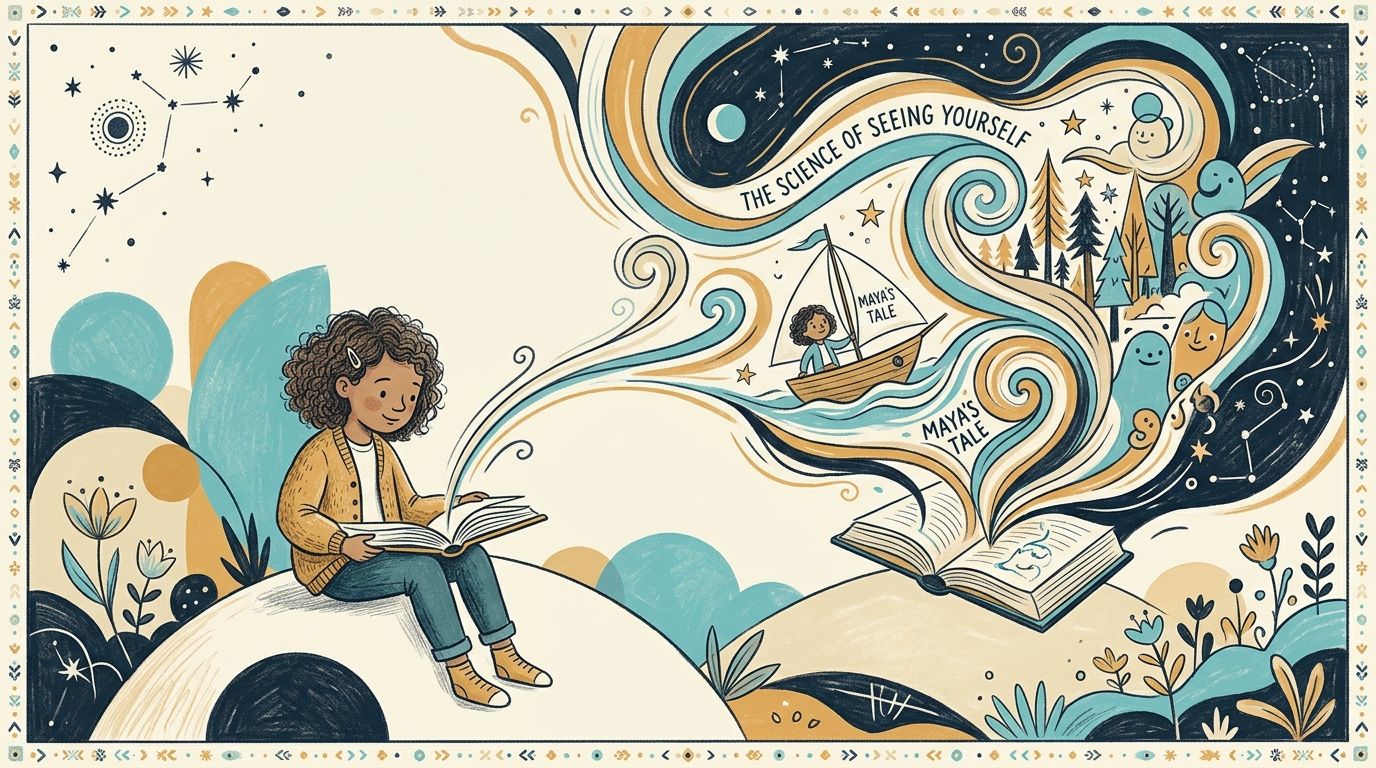
At the University of Sheffield, researcher Natalia Kucirkova observed that children are three times more likely to use complex, "literary" vocabulary when describing a story that centers on their own lived experiences. This phenomenon, often referred to in developmental psychology as the self-referencing effect, suggests that the human brain does not process all information with equal priority. Instead, it creates a preferential pathway for data that relates to the self. When a name, a familiar neighborhood, or a personal characteristic appears on the page, the brain treats the narrative not as an abstract exercise, but as vital personal history.
This deep level of engagement is not merely a matter of vanity or novelty. It is a fundamental shift in how the mind allocates cognitive resources. In a standard story, a reader must spend considerable mental energy building the world from scratch—imagining the protagonist’s face, their house, and their motivations. When those elements are already familiar, that energy is redirected toward the nuances of the plot, the rhythm of the language, and the emotional stakes of the journey.
The Mirror and the Window
In 1990, Dr. Rudine Sims Bishop introduced the concept that books should serve as "mirrors, windows, and sliding glass doors." A mirror allows a child to see their own life reflected as part of the human experience, validating their existence in the world of ideas. A window allows them to look into the lives of others, while a sliding glass door invites them to step into a different reality entirely.
Personalization is the most direct way to create that mirror. When a story includes a reader's specific cultural background or family structure, it reduces the "distance" between the reader and the text. This proximity is essential for retention. Studies in educational psychology indicate that children who see their own identities represented in their reading materials show a marked increase in reading frequency. They are not just reading a book; they are exploring a world where they belong.
Cognitive Load and the Architecture of Memory
The brain’s ability to remember a story is tied to its ability to organize information into "schemas" or mental frameworks. When a story is personalized, it hitches a ride on an existing schema—the one we have for ourselves. This is why a child can often recount every detail of a birthday party from three years ago but might struggle to remember the plot of a generic fable they read yesterday.
By grounding a story in the familiar, authors can introduce more complex themes and vocabulary without overwhelming the reader. Because the "who" and the "where" are already established in the reader's mind, the "what" and the "how" can become more sophisticated. This allows the story to grow alongside the reader, moving from simple identification to complex world-building and character development.
Narrative Agency and the Transition to Authorship
One of the most significant consequences of personalized storytelling is the shift from being a passive consumer to an active builder. When a reader realizes that their own life is "story-worthy," the barrier to entry for writing their own tales begins to crumble. This is the moment an idea becomes a seed for something larger.
When a builder begins a project on Inky, they are not just consuming a plot; they are establishing a canon where no two worlds alike exist, because every world is rooted in the specific identity of its creator. This sense of ownership changes the way a person interacts with the community. They are no longer just looking for a story to pass the time; they are looking for a universe to inhabit and expand. This transition is vital for developing "narrative agency"—the belief that one has the power to shape and tell their own story, rather than just reading the stories others have written for them.
The Global Reach of the Personal
Personalization also plays a critical role in global literacy and inclusion. For a reader in a region where books are rarely translated into their local language or where the settings feel entirely foreign, a story that can be adapted to their specific world is a bridge to the rest of the global community. It allows for a "bottom-up" approach to storytelling, where the canon is not dictated by a single publishing house in a single city, but is grown by authors with soul from every corner of the earth.
This inclusivity ensures that the stories being told are as diverse as the people reading them. It allows for a parent in a remote village to narrate a bedtime story that feels just as immediate and relevant as a story told in a major metropolis. The technology of storytelling is at its best when it disappears, leaving only the connection between the teller and the listener.
The long-term retention of a story’s moral or lesson is significantly higher when the reader believes the events of the narrative could, or did, happen to them.
Newsletter
A little more wonder, weekly.
Story ideas, parenting reads, and what we’re building next.
Like this? There's one more next week
Free weekly note on using stories to navigate the things parenting books skip.
No spam. Just story inspiration and new feature updates.
Written by
Founder, Inky
Building Inky — an AI storytelling studio for personalized, imaginative stories. Writing about raising readers and creativity.