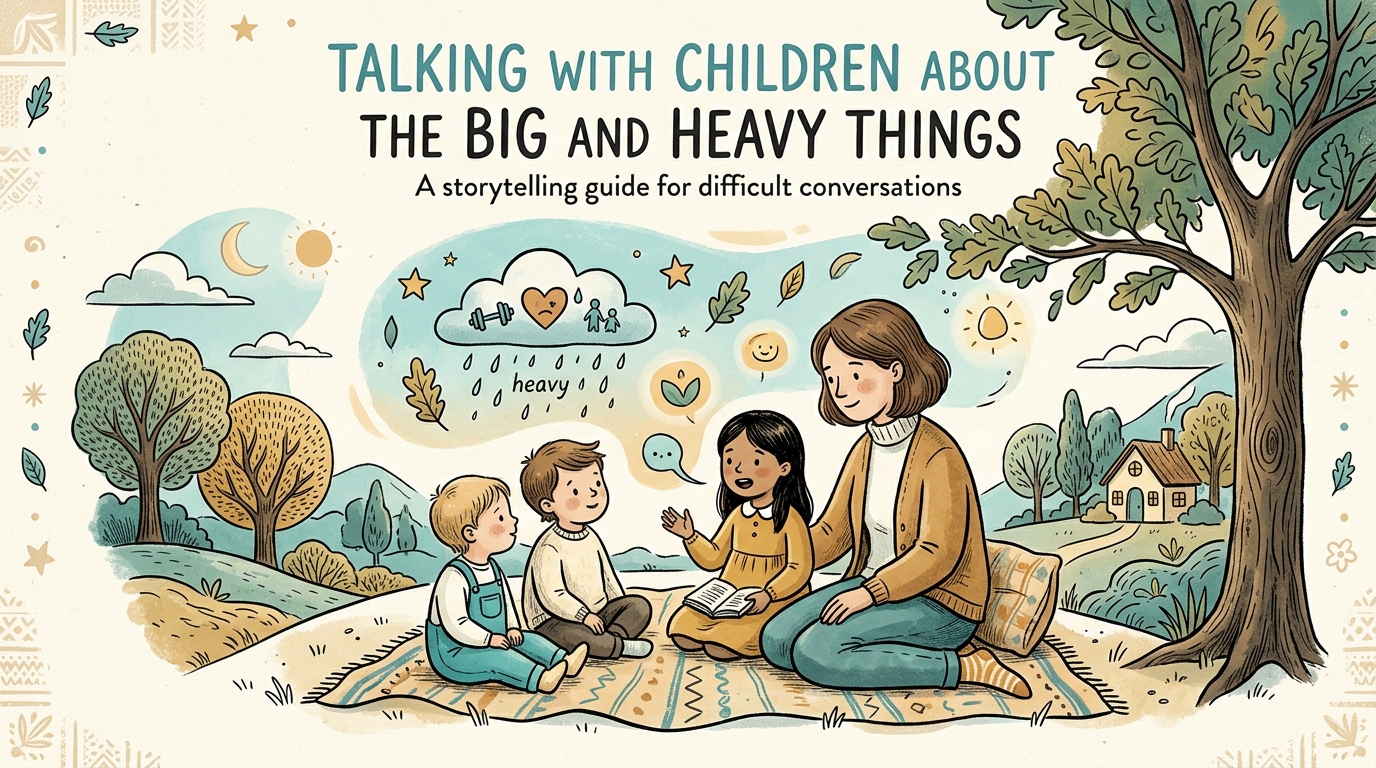
When seven-year-old Nora looked at the empty armchair in her grandmother's house in Chicago, she asked, "Where did the rest of Gran go?" It was a quiet afternoon following a funeral, and like many adults in that room, her father felt the sudden urge to reach for a soft fairy tale or a gentle myth to cushion the blow. But young minds do not need intricate evasions when the ground shifts beneath their feet; they need an honest anchor. Before we weave tales or seek comfort in books, the work of addressing grief, separation, or big emotional storms begins with simple, unflinching clarity.
The Direct Truth Before the Metaphor
Children are remarkably perceptive readers of the room, yet soft language like "went to sleep" or "moved to a better place" can inadvertently introduce fear into everyday routines like bedtime or packing a suitcase. When explaining death, using the actual words—that someone's body stopped working and they died—creates a clear, stable foundation. In the same way, when addressing divorce or a home splitting into two households, stating clearly that the grown-ups could not live together peacefully anymore, but that the child remains entirely loved and safe, prevents the young imagination from inventing blame.
Clear truth acts as the bedrock of any world we build with a child. Once that ground is firm, metaphor and narrative can do their real work. If the facts are cloudy, a story becomes a distraction rather than a lantern. State what happened in plain, warm terms, and let those plain terms settle before inviting the broader imagination to help process what comes next.
Story as a Map, Not a Shield
Storytelling is not a way to hide from hard realities; it is a way to step back far enough to view them without being overwhelmed. A child standing in the middle of a forest fire cannot admire the trees, but a child looking at a painted map of that same forest can trace the path through the smoke. This is the power of narrative distance.
When a family goes through a seismic shift, introducing characters who navigate parallel landscapes allows a child to explore complex emotions from a safe vantage point. A brave little river otter learning to swim across two different bankside burrows gives a child a way to talk about moving between two houses without forcing them to directly dissect their own anxiety. They can talk about the otter's nervous paws, the otter's heavy chest, or the otter's quiet hope, and in doing so, speak their own truth through a surrogate voice.
Giving Big Feelings Their Own Shape
Anger, grief, and confusion often feel like wild weather inside a small chest. Storytellers have long known that the best way to handle an invisible giant is to give it a name, a color, and a physical shape.
Instead of asking a six-year-old to articulate abstract grief, invite them to imagine grief as an unexpected creature that walked into the kitchen. Is it heavy like a wet boulder? Does it sit on your shoulders while you eat breakfast? Does it shrink when we draw pictures together or expand when the room gets too quiet? By treating an overwhelming emotion as a tangible visitor in the story-world, you give the child permission to coexist with it rather than run from it. The feeling becomes something outside of themselves—something that can be observed, talked to, painted, or eventually guided out the door.
Listening for the Details They Add
When a child begins to feel safe within a narrative, they will start contributing their own details to the story. Pay close attention to what they bring into the world: a dragon that refuses to sleep, a ship that lost its anchor, or a tree house where nobody is allowed to yell.
These creative choices are not random play; they are clues to what the child is carrying. Rather than correcting their narrative or steering it toward a quick resolution, enter the story alongside them. Ask open questions about their world. When you ask why the dragon stays awake or where the ship wants to sail next, you tell the child that their inner landscape is worth exploring and that their feelings make sense.
Leaving Space for the Unfinished Page
The most profound stories do not wrap every thread into a neat bow on the final page. When children face genuine hardship, forcing a tidy happy ending can feel false, teaching them that uncomfortable feelings ought to be rushed out of sight.
Allow the conversation to remain open-ended. Tell your child that some chapters take a long time to read, and that it is entirely fine if we do not know what happens on the next page yet. Inky offers spaces where families can sketch these evolving story-worlds together, turning chaotic days into shared tales where every emotion gets a seat around the campfire. When a child knows their real feelings can live inside a story without breaking it, they learn that no loss or change is too heavy to carry together.
Newsletter
A little more wonder, weekly.
Story ideas, parenting reads, and what we’re building next.
Like this? There's one more next week
Free weekly note on using stories to navigate the things parenting books skip.
No spam. Just story inspiration and new feature updates.
Written by
Founder, Inky
Building Inky — an AI storytelling studio for personalized, imaginative stories. Writing about raising readers and creativity.

