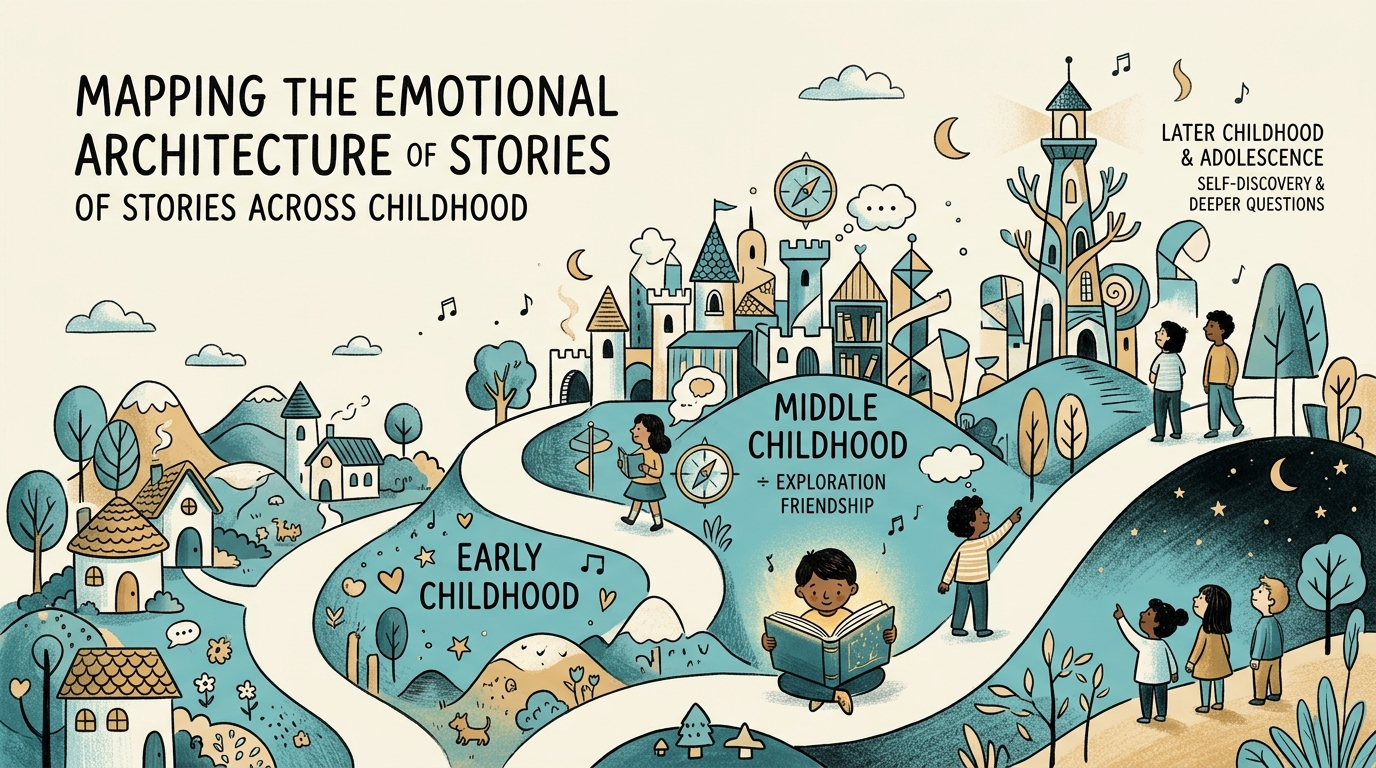
Maurice Sendak once told an interviewer that "children are tough," a perspective that anchors the 4 specific shifts in narrative complexity as a reader grows. This toughness is not a lack of sensitivity but a profound capacity for processing the world’s wonder and its shadows, provided the story meets them where they are. When we look at a story through the lens of age-band discovery, we aren't just looking at word counts or sentence lengths; we are looking at the emotional architecture of the world being built. A theme like "adventure" vibrates at a different frequency for a four-year-old than it does for a fourteen-year-old, and understanding those frequencies is the first step in crafting a world that lasts.
The Sensory Anchor: Stories for Preschoolers (Ages 3–5)
For the youngest readers, a story is an act of naming the world. At this stage, themes are most effective when they center on the "here and now," a concept pioneered by educator Lucy Sprague Mitchell. For a preschooler, a story about a lost red mitten is as high-stakes as a galactic rebellion is for an adult. The narrative world is small, tactile, and deeply rooted in sensory detail.
Short stories for preschoolers succeed when they focus on rhythm, repetition, and the mastery of daily life. The "adventure" here is often a sequence of familiar events with one small, manageable surprise. The theme of friendship isn't about complex social politics; it is about the physical act of sharing a block or the feeling of sitting next to someone in the grass. These stories provide a sense of order. When a story repeats a phrase or a sequence, it allows the child to predict the future, building a sense of safety and competence within the world of the book.
The Expansion of Agency: Adventure for Early Elementary (Ages 6–8)
As a child enters the 6-to-8-year-old range, the boundary of their world pushes outward. This is the era of the "first adventure." Adventure stories for 6-year-olds begin to introduce true agency—the idea that the protagonist can solve a problem without the immediate intervention of an adult. The themes shift from naming the world to navigating it.
In this age band, the theme of "discovery" often takes the form of a secret. Whether it is a talking animal in the backyard or a hidden door in the attic, the story grants the reader access to a layer of reality that the "grown-up" world cannot see. This is where the seed of a series is often planted. Readers at this age are beginning to understand continuity; they want to know that if a character finds a magic stone on page ten, that stone still exists in the next chapter. The world starts to have rules, and the thrill of the story comes from watching a character learn to use those rules to their advantage.
The Architecture of Continuity: World-Building for Tweens (Ages 9–12)
By the time a reader reaches the 9-to-12-year-old band, they are no longer just looking for a story; they are looking for a canon. This is the age of the "expert reader," someone who will notice if a character’s eye color changes between book one and book four. Themes of justice, sacrifice, and the "chosen one" become prominent because tweens are beginning to grapple with their own place in a much larger, often confusing social structure.
World-building becomes a primary draw. For these authors, the goal is to build a world with enough depth that the reader can imagine living there. This is where the concept of a "living story-world" truly takes hold. Themes are often explored through the lens of systems—magic systems, political systems, or ecological systems. A story about an underwater city isn't just about a single quest; it is about how that city breathes, what it eats, and who makes the laws. On Inky, this is the stage where readers often transition into authors, realizing that once the rules of a world are established, they can grow the universe by adding their own chapters or spinning off new characters from the existing canon.
The Mirror of Identity: Complexity for Teens and All-Ages
For teens and adults, the story serves as a mirror and a laboratory. The themes of the previous years—safety, agency, and systems—are now complicated by the introduction of moral ambiguity. The "adventure" is no longer just a physical journey; it is an internal one. Themes of identity, belonging, and the subversion of power take center stage.
In this final band, the world-building must be robust enough to handle contradiction. The hero might be wrong; the villain might have a point. The reader is looking for a story that acknowledges the complexity of the human experience while still offering the wonder of a world realized in full detail. Whether it is a sprawling space opera or a grounded contemporary drama, the narrative succeeds by being true to its own internal logic. The story-world becomes a place where ideas become worlds, allowing the author to test-drive different versions of reality.
A story that respects the specific emotional landscape of its age group creates a world that survives long after the book is closed.
Newsletter
A little more wonder, weekly.
Story ideas, parenting reads, and what we’re building next.
Like this? There's one more next week
Free weekly note on using stories to navigate the things parenting books skip.
No spam. Just story inspiration and new feature updates.
Written by
Founder, Inky
Building Inky — an AI storytelling studio for personalized, imaginative stories. Writing about raising readers and creativity.