Nine-year-old Maya asked her father if deep-sea octopuses ever throw lantern parties, and by eight o'clock that evening, they had constructed the sunken city of Oakhaven together. Her octopus wore a copper helmet with a tiny candle inside, trading glowing seashells with a whale who collected antique clocks. The story was fully painted in warm indigo hues, read aloud by a narrator who sounded like an old sailor, and placed directly on her nightstand shelf to be revisited tomorrow.
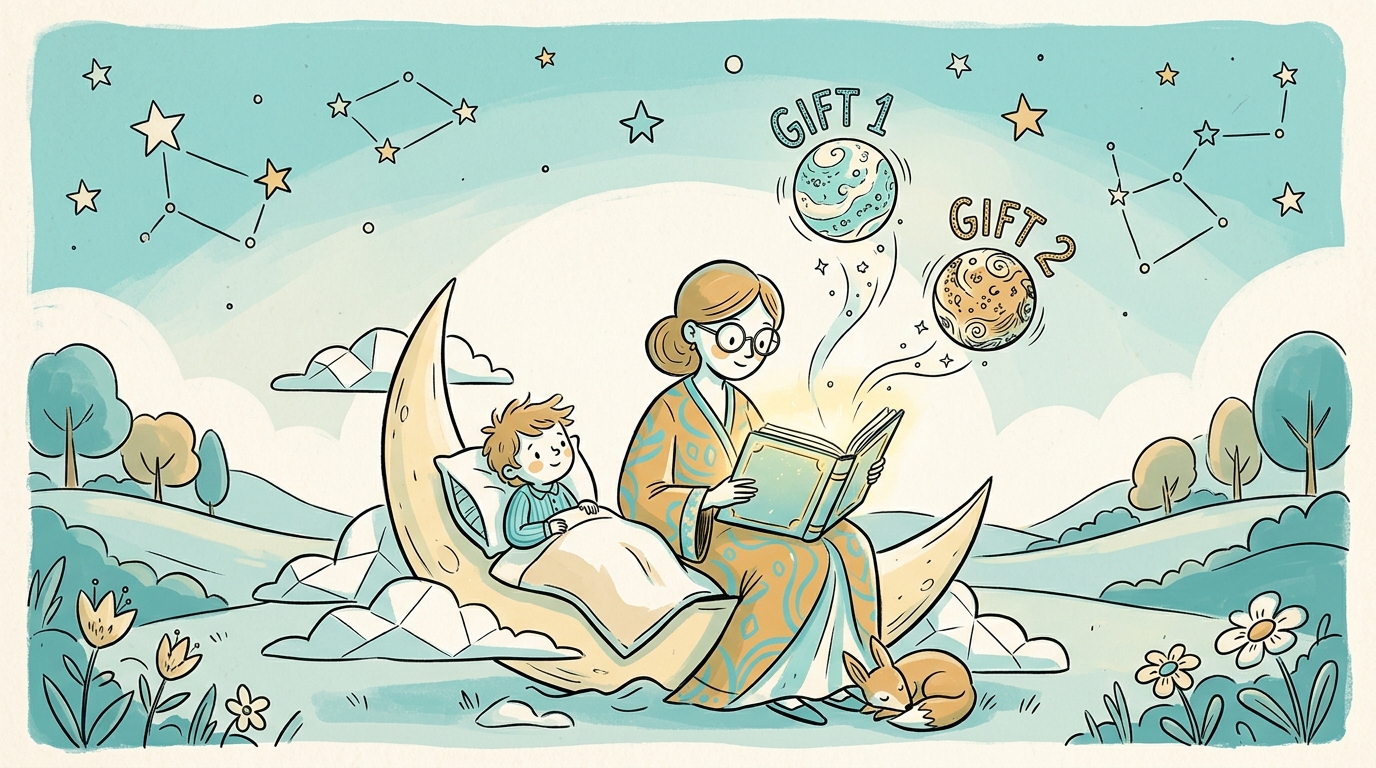
When bedtime becomes a negotiation over the same worn picture books or disposable digital feeds, parents do not need another software explanation to evaluate. They need to know if a single spark from their child’s imagination can turn into a living place with real emotional resonance. Giving every new reader two complete credits upon arrival answers that question immediately, allowing families to build, illustrate, and listen to two entire stories before anyone ever mentions payment details.
What readers on r inkyverse look for in a bedtime story
Discussions across r inkyverse consistently center on the difference between a throwaway tale and a true story-world. Parents writing about evening routines describe tired kids who spot manufactured plotlines from a mile off. A story generated as a generic template forgotten five minutes later offers no lingering magic.
What catches a child’s attention is specific, personal canon. When a boy asks why his wooden toy train has a rusted bolt on the caboose, he is not asking for a stock fairy tale about a train whistle. He wants to know who forged that bolt, what storm bent it, and whether the driver keeps an extra key in his leather boot. A real bedtime world gives that rusted bolt a history, an illustration, and a voice. Two credits provide enough room to explore two distinct questions: one to test how the child responds to seeing their passing thought turned into painted art and spoken narration, and a second to see if they want to revisit that world or expand it into something larger.
What happens in two full credits
A single credit yields a complete story, not a sample chapter or an abridged preview. It means full canvas illustrations for every scene, full voice narration tuned to the tone of the tale, character portraits that stay consistent across pages, and an archived world entry that belongs to the family forever.
In the first credit, a family might construct a desert sanctuary where rescue badgers build wind turbines out of fallen tea tins. The child hears their own odd details—the badger who wears brass reading spectacles, the windstorm that smells like dried cinnamon—woven into a structured narrative arc with quiet emotional weight.
The second credit allows for narrative choice. The family can choose to build a completely different universe—perhaps a cloud observatory managed by a solitary astronomer owl—or return to the badger sanctuary to see what happens when winter arrives. That choice reveals whether the child treats the story as a passing curiosity or the foundation of an ongoing series. By the time the second story closes, the family knows precisely how the world looks, sounds, and feels.
Testing a spark before building an archive
The craft of storytelling rests on trust between the storyteller and the listener. Forcing a family to enter payment details or navigate complex subscription charts before they have experienced a single quiet bedtime moment creates unnecessary friction.
The fastest way to learn if a child connects with a world is to make one tonight. Sitting at the edge of the mattress, turning an offhand comment about a stray cat or a missing mitten into a rich, painted tale with its own internal rules, proves whether the experience earned its place on the bookshelf. If the child falls asleep asking what lies past the mountain pass in chapter two, the story did its work.
Where ideas become worlds, ownership remains with the child who dreamed them. Providing two full credits up front ensures that every family can experience that transition firsthand, leaving two painted, narrated universes standing on the nightstand long after the lights go out.
Newsletter
A little more wonder, weekly.
Story ideas, parenting reads, and what we’re building next.
Like this? There's one more next week
Free weekly note on using stories to navigate the things parenting books skip.
No spam. Just story inspiration and new feature updates.
Written by
Founder, Inky
Building Inky — an AI storytelling studio for personalized, imaginative stories. Writing about raising readers and creativity.

