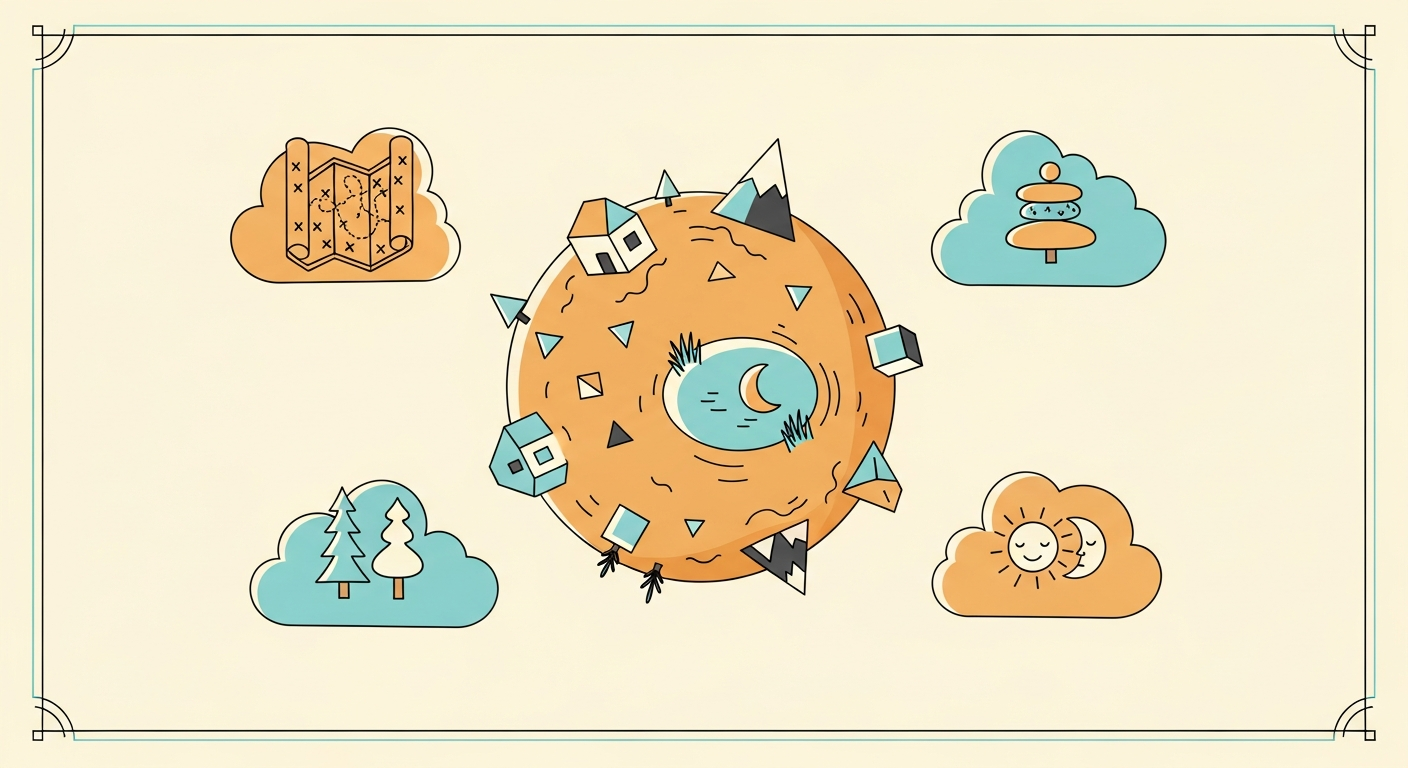
When kids fall in love with story worlds - Hogwarts, Narnia, Hundred Acre Wood - they want to return again and again. Creating a consistent world for your child's stories builds anticipation: "Tell me another story from that place!"
World-building isn't just for fantasy novels. Even simple worlds (a neighborhood, a forest, a school) benefit from consistent details that make them feel real and inviting.
The Minimal Viable World
You don't need a thousand-page encyclopedia. Kids need three things to feel grounded in a world:
1. Three Key Locations
Home base (where character lives/starts adventures). Challenge zone (where problems happen). Secret spot (special place only certain characters know about).
Example: Home base = cozy treehouse. Challenge zone = mysterious forest. Secret spot = hidden waterfall cave.
Map these three places with your child. Draw a simple map and post it where you both can reference it during story creation.
2. One Simple Rule
What makes this world special or different? Pick ONE element:
- All animals can talk
- Time moves differently (one day here = one hour there)
- Music creates magic effects
- Everyone has one special ability
- The weather reflects emotions
This one rule stays consistent across all stories in this world. Consistency makes worlds feel real.
3. Recurring NPCs
Create 2-3 characters who appear regularly: A helper (gives advice, provides tools). A friendly rival (creates healthy competition). A mysterious figure (appears occasionally with clues).
These recurring characters make the world feel populated and familiar. Kids get excited when familiar faces appear: "It's the map-maker again!"
Sensory World-Building
Kids remember worlds through senses, not descriptions. Make your world distinctive by assigning sensory signatures:
- Sound: "Wind that whispers riddles" or "Bells that ring when someone tells the truth"
- Smell: "Forest that smells like cinnamon" or "Ocean that smells like vanilla"
- Visual: "Sky that changes color with the seasons" or "Trees with silver leaves"
- Texture: "Grass that feels like velvet" or "Stones that hum when you touch them"
One memorable sensory detail makes the world stick in kids' minds. They'll reference it in conversation: "Like the cinnamon forest!"
The Lore Log: Keeping Track
Use a simple notebook as your "world encyclopedia." After each story, add:
- New locations discovered
- New characters met
- Rules or facts learned about the world
- Ongoing mysteries or questions
Kids LOVE contributing to the lore log. It makes them co-creators of the world, not just consumers of stories.
Letting Worlds Evolve
Each week, let your child add ONE new element: new location, new character, new discovery about the world rule. This slow evolution maintains consistency while preventing boredom.
Ask: "What should we add to our world this week?" Write it in the lore log, then incorporate it in the next story.
Age-Appropriate Complexity
Ages 4-6: Keep It Tiny
3 locations total. 1 simple rule. 2 recurring characters. Everything fits on one page of the lore log.
Ages 7-9: Expand Gradually
5-7 locations. 2-3 rules that interact. 4-5 recurring characters. Simple political structures (kingdoms, teams).
Ages 10-13: Add Depth
10+ locations with connections. Layered rules with consequences. 8-10 characters with relationships. History and factions. Mysteries that span multiple stories.
Success Story
"My daughter and I created "Shimmer Valley" - a world where music creates magic. We started simple: 3 locations, 2 characters, 1 rule. Six months later, she's added 12 locations, drawn detailed maps, and written 20+ stories set there. World-building turned her into a passionate writer." - Elena R., mom of 9-year-old
Conclusion
Simple worlds with clear rules invite kids to return to reading. Start tonight: define 3 places, 1 rule, 2 characters. Draw a map together. Then create your first story in that world using Inky. Watch your child's universe grow, one story at a time.
Newsletter
A little more wonder, weekly.
Story ideas, parenting reads, and what we’re building next.
Like this? There's one more next week
Free weekly note on using stories to navigate the things parenting books skip.
No spam. Just story inspiration and new feature updates.
Written by
Founder, Inky
Building Inky — an AI storytelling studio for personalized, imaginative stories. Writing about raising readers and creativity.


