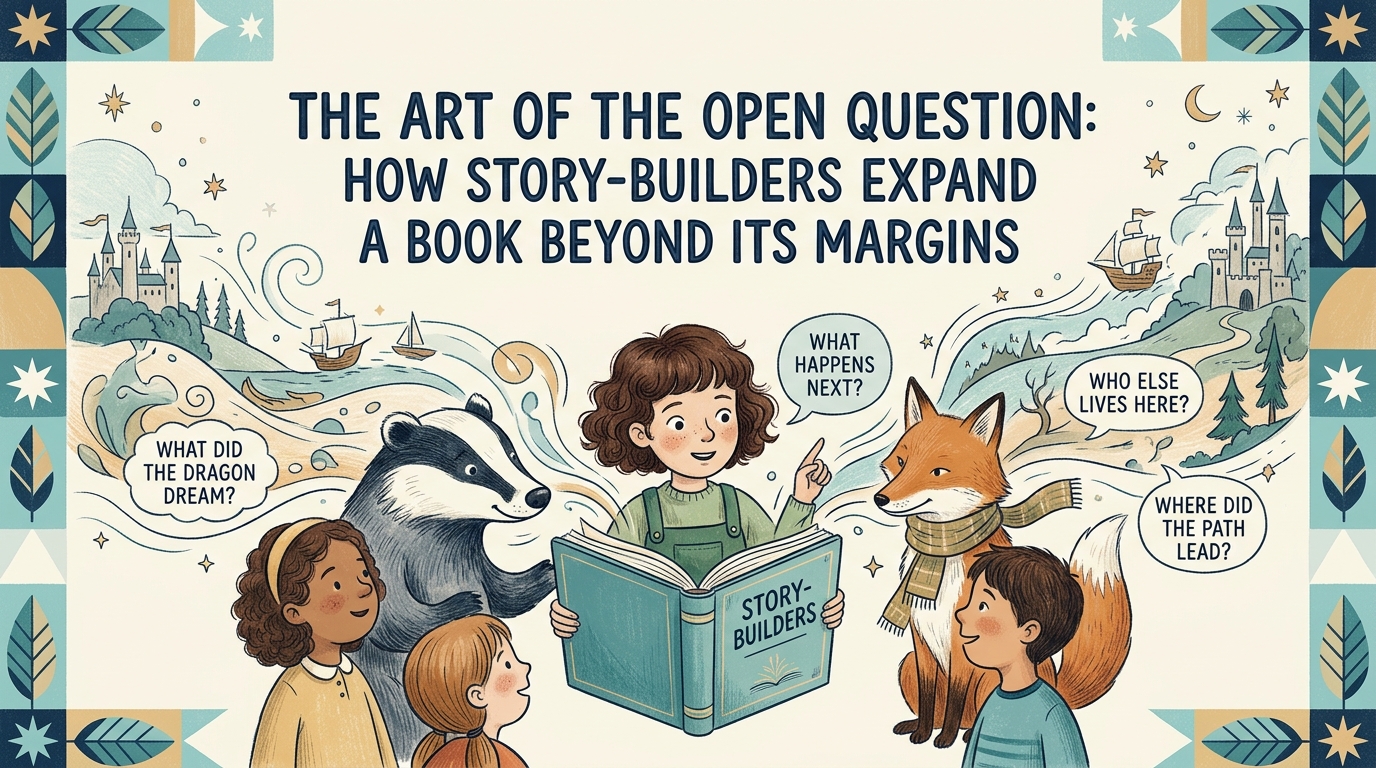
In 1988, researchers at Stony Brook University recorded how thirty children under three reacted when their parents stopped treating picture books as scripts and started treating them as conversations. The shift was simple: instead of reading every printed line straight through, adults began asking questions that required the child to look closer, describe details, and invent reasons for what was happening on the page. The children did not just learn words faster. They began viewing the book as a place where their own thoughts belonged.
Every story ever bound between covers carries a hidden truth: the printed words show only a tiny fraction of the world. The rest of that universe lies just beyond the edges of the illustration, waiting for someone to wonder about it. When we read with a kid, our questions act as a lantern. If we only ask recall questions—testing whether they remember the color of a bear's hat or the name of a village—we treat the story like a test to pass. But when we ask open questions that have no single printed answer, we hand them the quill. We invite them to step across the boundary from listener to author.
Questions That Map the Unseen Landscape
A standard reading comprehension check asks for facts already settled by the illustrator or the writer. Generative questions ask for the details that the author left unwritten. They invite the child to build canon on the fly.
When a character pauses before entering a dark hollow in an old oak tree, a quiz question asks, "Is the tree tall?" A world-building question asks, "What do you think the squirrel keeps hidden in the root cellar underneath that trunk?"
The difference lies in creative agency. The first question requires memory; the second requires imagination anchored in evidence. To answer the second, a child must look at the moss on the roots, consider the weather in the illustration, and draw upon what they already know about how creatures survive a long winter. They are no longer merely tracking a plot. They are inventing the geography of a realm.
To start mapping these unseen corners during bedtime or classroom reading, try steering toward three specific directions:
- Motive and Secret History: "Why do you think the lighthouse keeper refuses to turn off her lantern, even when the sun comes up?"
- Sensory Boundaries: "If you stepped into this illustration right behind the main character, what would the grass smell like after that sudden rain?"
- Consequence and Logic: "If the fox leaves his compass behind on the riverbank, how will he find his way across the mountain before nightfall?"
Establishing Canon at the Crossroads
Children are natural world-builders. They intuitively understand that every living story operates under rules, even if those rules involve talking trees or oceans made of glass. When a story reaches a turning point, pausing to ask about the rules of the realm gives the child permission to co-create the plot.
In early literacy research, this practice aligns with dialogic reading—a structured way of prompting, evaluating, and expanding a child's spoken responses. But in the hands of a storyteller, it is simply the act of expanding a universe together. When a hero stands before three closed doors in a castle wall, asking "Which door would you open?" is a start. A far richer prompt is: "What rule in this kingdom determines which door is safe, and how could our hero figure it out?"
Suddenly, the child must evaluate the clues scattered across the page. They might point to the carving of a moon above the middle arch or notice that the key in the hero’s hand has three notches. When they answer, their decision establishes a truth that carries forward into the rest of the book. Their answer becomes part of the world's permanent record.
Turning Listening into World-Building
The most powerful moment in any shared story occurs when the narrative touches something in the reader's real experience. Literacy experts call this a distancing question—a prompt that bridges the fictional world with the child's lived reality.
When a character in an illustrated tale builds a shelter out of fallen bark to escape a storm, ask: "If a storm hit our backyard tonight, what around our house would you gather to build a fortress for the birds?"
This bridge works in both directions. It brings the magic of the story-world into the living room, and it brings the child’s personal knowledge back into the story. It proves to young minds that their own observations and ideas are valuable raw material for storytellers. An idea is a seed, and a single open question provides the soil it needs to take root and grow into a full universe.
When a child realizes that their perspective can alter how a story unfolds, reading ceases to be a quiet exercise in paying attention. The book stops being a static object on a paper page and becomes an entry point into a living world they have the power to help shape.
Newsletter
A little more wonder, weekly.
Story ideas, parenting reads, and what we’re building next.
Like this? There's one more next week
Free weekly note on using stories to navigate the things parenting books skip.
No spam. Just story inspiration and new feature updates.
Written by
Founder, Inky
Building Inky — an AI storytelling studio for personalized, imaginative stories. Writing about raising readers and creativity.