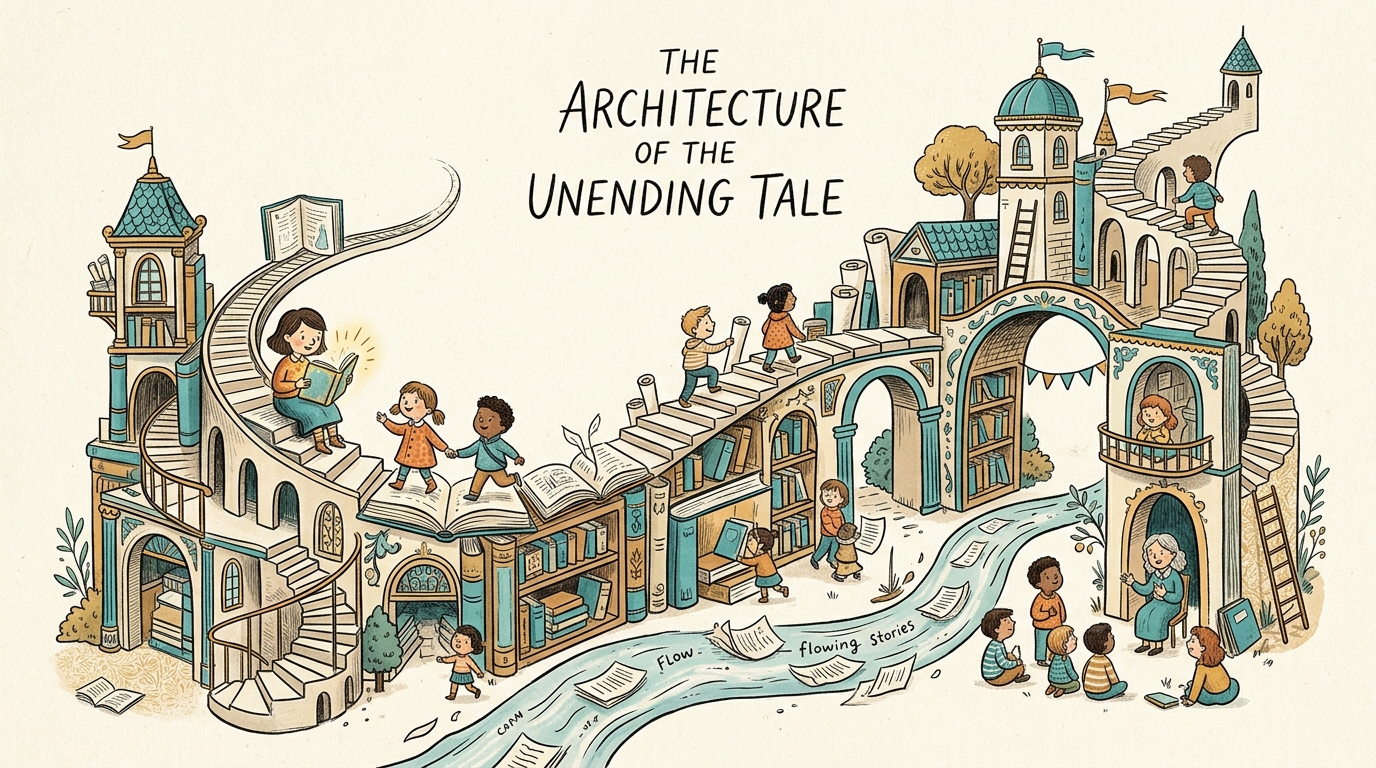
When folklorist Antti Aarne published his first catalog of story structures in 1910, he identified 540 distinct patterns that human beings had been telling each other for thousands of years.
These structures were not rules meant to cage the imagination. They were architectural blueprints, quiet maps of human memory passed down through hearthside voices, market plazas, and bedside traditions across every continent. When researchers later expanded Aarne's work to cover thousands of variations across thousands of cultures, a striking truth emerged: humanity does not tire of the same core story shapes because a story shape is never the whole world. It is merely the seed from which a world grows.
Understanding how these foundational patterns function is one of the most powerful tools an author can hold. When you see how the same underlying skeleton carries a wildly different spirit in the icy tundra than it does in a salt marsh or an orbital station, you realize that original world-building is rarely about inventing a shape no human has ever imagined. It is about taking a shared spark and giving it fresh soil, new sensory detail, and characters with real soul.
The Seed and the Soil
Consider the classic pattern of the persecuted wanderer given three impossible tasks—a tale shape found in nearly every recorded language. In Norway, the story becomes East of the Sun and West of the Moon, where a young woman travels on the back of the North Wind to rescue a prince trapped in a castle forged of iron and ice. In China, a parallel thread unfolds through the tale of Ye Xian, where the magical helper is not a bear or a bird, but a golden-eyed fish in a sunken stone pond, and the crucial test involves slippers woven from spun gold.
The underlying structure remains constant: a promise broken, a journey across impossible boundaries, and a series of trials solved through unexpected kindness rather than brute force. Yet no reader sitting by a fire in Telemark would confuse their story-world with one told along the banks of the Pearl River.
The difference lies entirely in the soil. Soil is the environment, the local magic, the social customs, and the physical texture of the world you build around the framework. The Norwegian tale breathes with the bite of pine needles and frostbite; the Chinese tale smells of river silt and silk slippers. The pattern provides the structural momentum, but the world-builder provides the life.
Three Blueprints for Living Worlds
If you want to use classic story structures to ground an original universe, three timeless patterns offer rich ground for expansion:
The Trickster’s Wager. From Anansi in Ghana to Maui across the Pacific, this pattern pits cleverness against overwhelming force. The protagonist rarely possesses armor or an army; instead, they use speech, trickery, and an understanding of their opponent's vanity to bend the rules of the world. When building around this blueprint, the focus belongs on the rules themselves. A trickster story only shines when the world's physical or magical laws are established clearly enough for the audience to appreciate the exact moment the protagonist bends them.
The Animal Bridegroom. Found in tales from Indigenous North America to classical Rome, this structure explores the tension between external appearances and hidden truths. A character enters a world defined by a strict boundary or a terrifying transformation, learning to navigate an unfamiliar kingdom before betrayal or curiosity shatters the sanctuary. This blueprint relies heavily on sensory immersion: the echo of a cavernous stone hall, the smell of woodsmoke in a winter cabin, or the quiet weight of a secret kept between two people.
The Journey to the Lost Realm. Whether it is Orpheus descending into the underworld or a child stepping through a hollow tree into a kingdom of forgotten things, this pattern tests how far a character will go to restore what was broken. The power of this structure rests in its emotional cost. The lost world must feel fully realized, with its own history, language, and logic, making the protagonist's choice to remain or return carry genuine narrative weight.
Making the Blueprint Your Own
To turn an ancient pattern into a living world, start by altering the core motivation. If a traditional tale demands that a hero fight a dragon to claim a crown, ask what happens if the protagonist seeks the dragon's guidance to save an ailing forest instead.
Next, anchor the narrative in specific, lived detail. A magic key is generic; a tarnished iron key that smells of salt and leaves black soot on the palm belongs to a specific place and time. When an author treats every object, creature, and landscape as a permanent piece of a broader canon, the universe expands far beyond the bounds of a single plotline.
Storytelling has always been a communal act of borrowing, reshaping, and passing forward. When you write into an established pattern, you are not copying what came before; you are joining a global conversation that has been echoing for centuries. The pattern holds the room, but your voice lights the fire.
In the end, the most enduring story-worlds are those that feel infinitely expandable. When a reader finishes a journey through your universe, the ultimate reward is not just that they enjoyed the ending, but that they can look at the map you drew and imagine a hundred other stories waiting just beyond the border.
Newsletter
A little more wonder, weekly.
Story ideas, parenting reads, and what we’re building next.
Like this? There's one more next week
Free weekly note on using stories to navigate the things parenting books skip.
No spam. Just story inspiration and new feature updates.
Written by
Founder, Inky
Building Inky — an AI storytelling studio for personalized, imaginative stories. Writing about raising readers and creativity.