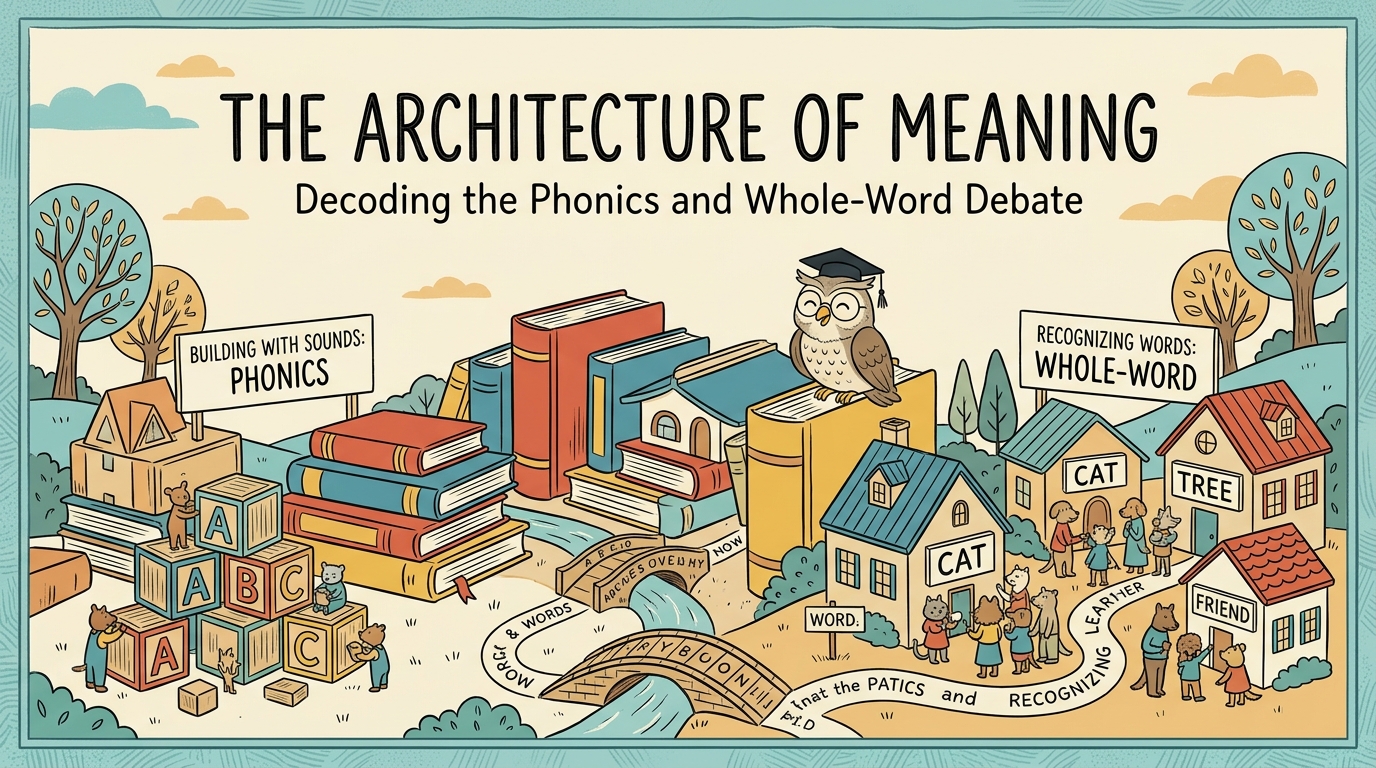
Rudolf Flesch published Why Johnny Can’t Read in 1955, a book that catalyzed a national conversation about the mechanics of how a child’s brain translates ink into ideas. His critique of the American education system’s move away from phonics-based instruction touched off a debate that has persisted for nearly seventy years. At the heart of this conflict is a fundamental question about the nature of literacy: do we learn to read by breaking down the sounds of individual letters, or by recognizing the visual landscape of entire words?
The Mechanics of the Code
Phonics instruction operates on the principle of the alphabetic code. English uses 26 letters to represent approximately 44 distinct sounds, known as phonemes. When a student learns phonics, they are learning the relationship between these sounds and the written symbols—the graphemes—that represent them. This is often described as a "bottom-up" approach. The reader starts with the smallest units of language and assembles them into syllables, then words, then sentences.
The strength of this method lies in its portability. A reader who understands that "ch" makes a specific sound and that "i" followed by a consonant and an "e" creates a long vowel can decode thousands of words they have never seen before. Research in the field of cognitive science, often grouped under the "Science of Reading" umbrella, suggests that this decoding process is a prerequisite for literacy. The brain does not naturally evolve to read the way it evolves to speak; it must repurpose areas originally designed for visual recognition and language processing to create a new "reading circuit."
The Shape of the Story
Whole-word instruction, or the "look-say" method, takes a "top-down" approach. This philosophy suggests that reading is a natural process similar to learning to speak, where children learn to recognize words as whole units based on their shape and context. In this model, a child might see the word "mountain" alongside an illustration of a peak and memorize the visual pattern of the word rather than sounding out the "m-ou-n-t-ai-n."
Proponents of this method, and the subsequent "Whole Language" movement, argue that focusing too heavily on phonics can make reading a clinical, tedious exercise that strips the joy from storytelling. They emphasize the importance of immersion in literature and using "three-cueing" systems—using graphic, syntactic, and semantic clues to guess a word. However, while this approach can lead to early wins with common sight words, it often falters when a reader encounters complex, unfamiliar vocabulary that cannot be guessed from a picture or the surrounding sentence.
What the Brain Beholds
Modern neuroimaging has provided a clearer picture of what happens inside the mind during these different instructional methods. Stanislas Dehaene, a cognitive neuroscientist, has documented how the brain’s "visual word form area" becomes specialized as a person learns to read. The research indicates that even skilled adult readers do not actually recognize words as whole shapes. Instead, the brain processes all the letters in a word simultaneously and maps them to their corresponding sounds with such speed that the process feels instantaneous.
This process is known as orthographic mapping. It is the mental mechanism that turns an unfamiliar string of letters into a recognized word that is stored in the long-term memory. Orthographic mapping is only possible when a reader has a strong grasp of phonemic awareness. Without the ability to map sounds to letters, the brain is forced to rely on rote memorization of visual shapes, which is a far less efficient and more limited way to store information. The capacity for memorizing whole shapes is finite, whereas the capacity for decoding is limited only by one's vocabulary.
From Decoding to World-Building
The goal of any reading instruction is to reach a state of "automaticity"—the point where the mechanics of decoding become so fluid that they require no conscious effort. Once the cognitive load of sounding out words is removed, the brain is free to focus entirely on comprehension, nuance, and imagination. This is the moment where ideas become worlds. A reader who is no longer struggling with the "how" of reading can begin to inhabit the "what" of the story, following characters through complex arcs and understanding the deep canon of a shared universe.
In a global community of storytellers, this transition is the gateway to participation. When a child in one part of the world reads a story written by an author on another continent, the bridge between them is the shared code of language. Whether that story is found in a printed book or in the digital library of Inky, the reader’s ability to decode the text is what allows the author's vision to take root in a new mind.
The most effective literacy instruction tends to be explicit and systematic, ensuring that every student has the tools to break the code. While the wonder of a story is what keeps a reader returning to the page, it is the foundational architecture of phonics that provides the stability for that wonder to exist. The transition from laboriously sounding out a single word to losing oneself in the history of a fictional empire represents the most significant cognitive leap a human being can make.
Newsletter
A little more wonder, weekly.
Story ideas, parenting reads, and what we’re building next.
Like this? There's one more next week
Free weekly note on using stories to navigate the things parenting books skip.
No spam. Just story inspiration and new feature updates.
Written by
Founder, Inky
Building Inky — an AI storytelling studio for personalized, imaginative stories. Writing about raising readers and creativity.