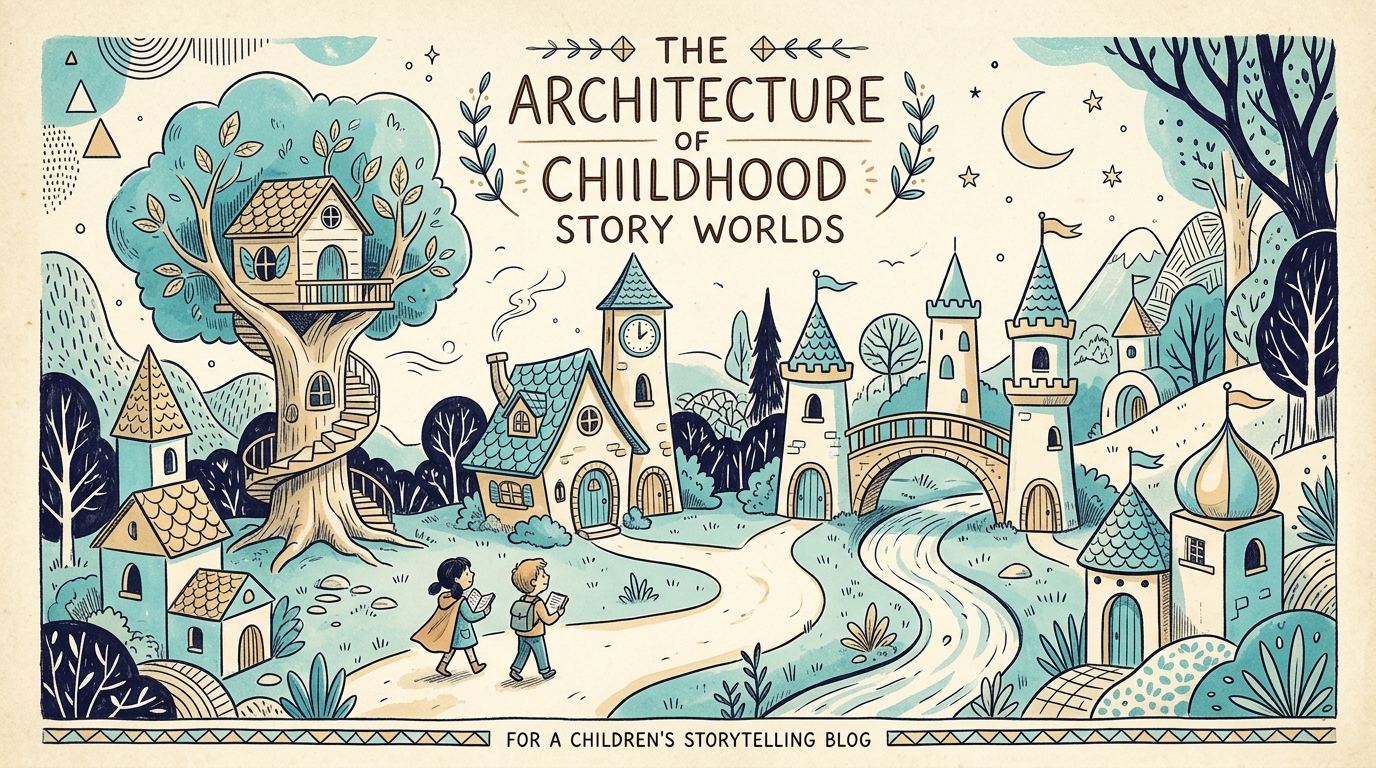
In the 1920s, A.A. Milne established the Hundred Acre Wood as a fixed geography where exactly ten major characters could interact across a series of interconnected tales. This shift from isolated fables to a persistent universe changed how readers engaged with stories. Instead of meeting a new protagonist every time they opened a book, they were visiting a place they already knew. The trees, the bridges, and the personalities of the residents remained constant, creating a sense of reliability that transformed a simple reading session into a form of mental residence.
The Logic of the Setting
A story world is a system defined by its own internal laws. When a setting is treated as a living entity, the rules of physics, biology, and history must remain consistent across every chapter. In a magical forest universe, the "magic" is not an unpredictable convenience used to solve plot holes; it is a feature of the environment. For example, if the silver-leafed oaks in a specific woods only speak to those who carry a piece of smooth river stone, every author and reader who enters that world must respect that law.
This consistency allows a child to move from being a spectator to a resident. When they know that the blue fireflies only emerge after a heavy rain, they begin to anticipate the world’s rhythms. They aren't just following a plot; they are learning the ecology of an imaginary place. This is the precise point where ideas become worlds—the transition from a fleeting thought to a setting with its own gravity and history that continues to exist even after the book is closed.
The Technological Frontier
In universes centered on science and machinery, the logic shifts from the mystical to the mechanical. A robot bedtime universe might be built around "Circuit City," a metropolis where every inhabitant is made of brass and powered by winding gears. In this world, the conflict isn't solved by a magic wand, but by a wrench or a new piece of code. A story about a small maintenance bot named Pip becomes part of a larger canon when the city he fixes in one book is the same city that faces a power shortage in the next.
These mechanical worlds offer a different kind of wonder, one rooted in how things work. When a child understands that the city’s lights only dim once the central clock strikes twelve, they are participating in a shared logic. This structure supports a series of stories that can grow indefinitely. If one author writes about the robots who live in the skyscrapers, another can imagine the tiny mechanical mice that live in the sub-basements. Both stories are true because they occupy the same map and follow the same physical laws.
Character Continuity and Growth
In a flagship universe, characters are not disposable. They have histories, preferences, and relationships that carry over from one story to the next. This continuity is what allows a nine-year-old to grow alongside a protagonist. In a series set in a coastal village where the ocean is filled with sentient kelp, a character might start as a curious observer and, five stories later, become the village’s primary navigator.
The presence of 131 authors-with-soul across these various worlds ensures that while the voices may change, the core of the character remains intact. This is not about a single person’s vision, but about a community’s commitment to a character’s life. When a secondary character in a story about a lighthouse keeper suddenly appears as the lead in a story about a deep-sea salvage mission, the universe feels vast and interconnected. The reader begins to look for these threads, connecting the dots between different corners of the map.
A Global Library of Shared Universes
The reach of a story world is measured by its ability to cross borders. Because these universes are translated into ~100 languages, a child in a mountain village can explore the same magical forest as a child in a coastal city. The world itself becomes a bridge. The regional specifics—whether a story is set in one of the 20 distinct world regions—add texture to the global canon without breaking the underlying rules of the universe.
This global architecture means that a parent building a bedtime universe for their child is contributing to a library that is free to read anywhere. The stories are not hidden behind engagement traps or manufactured metrics; they exist as part of a collective imagination. A teenager might write a story about a rogue robot in a shared sci-fi universe, and a week later, a reader on the other side of the planet might imagine what happens when that same robot finds a discarded map to a hidden forest.
The Consequence of a Living Canon
When a story world has its own canon, it ceases to be a static object. It becomes a space where anyone can build, provided they follow the established history. This allows for spin-offs that feel authentic rather than forced. If the Great Willow at the center of a forest is known to be the source of all water in the land, any story written about the surrounding plains must account for that fact.
This commitment to the world's history creates a sense of permanence. Authors are not just writing stories; they are adding layers of sediment to a landscape. When a child recognizes a secondary character from a previous book appearing as the protagonist of a new one, the boundaries of the page vanish and the world becomes a physical place in their memory.
Newsletter
A little more wonder, weekly.
Story ideas, parenting reads, and what we’re building next.
Like this? There's one more next week
Free weekly note on using stories to navigate the things parenting books skip.
No spam. Just story inspiration and new feature updates.
Written by
Founder, Inky
Building Inky — an AI storytelling studio for personalized, imaginative stories. Writing about raising readers and creativity.