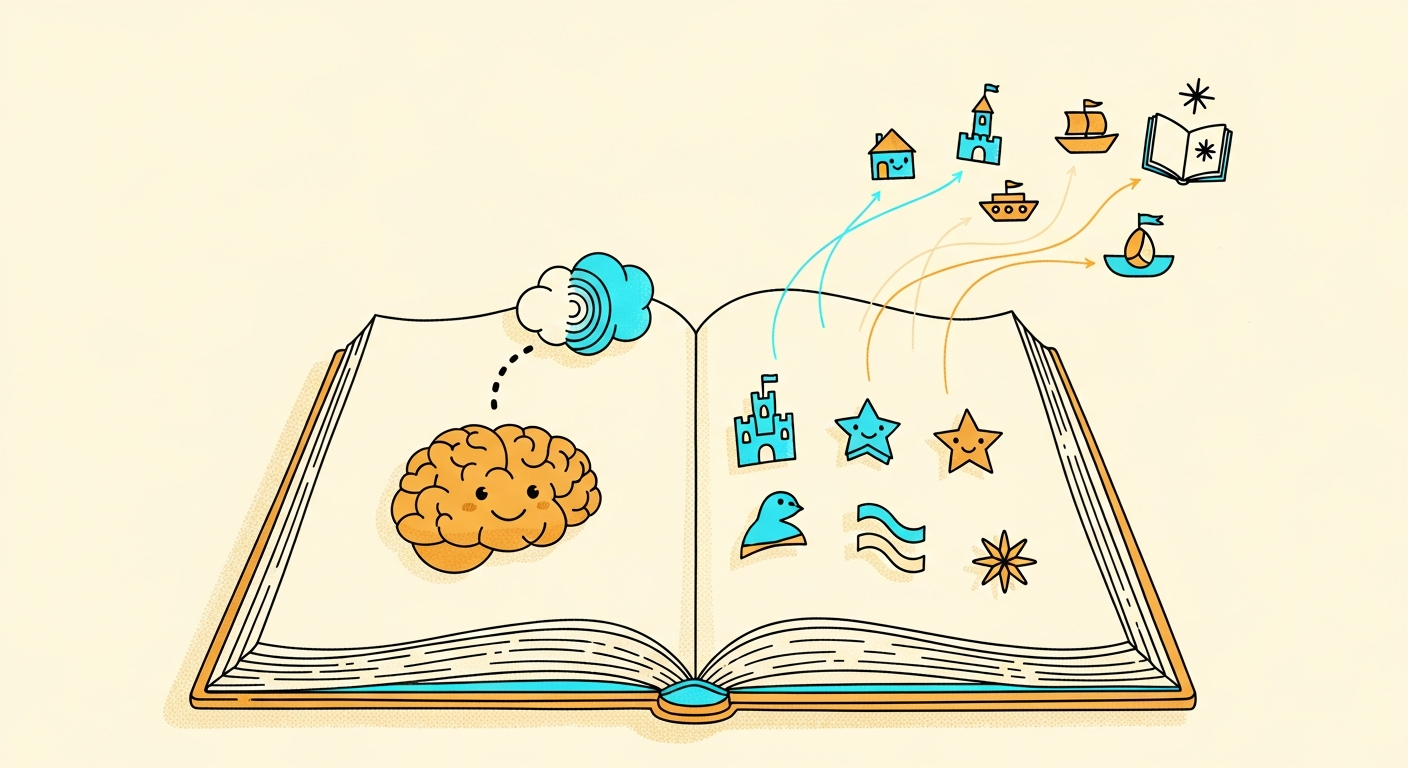
When children see themselves as the hero of a story, something remarkable happens in their brain. Neurological studies show that personalized narratives activate different regions of the brain compared to traditional stories - specifically areas related to self-identity, motivation, and memory formation.
This isn't just anecdotal - the science of personalized storytelling reveals why this approach is so powerful for child development and learning.
The Neuroscience of Self-Reference
When children hear their own name in a story, the brain's self-referential processing network lights up. This network, which includes the medial prefrontal cortex, is responsible for:
- Personal identity formation
- Emotional connection to information
- Memory encoding and retention
- Motivation and goal-directed behavior
A 2019 study published in the Journal of Child Psychology found that children showed 400% better retention of story details when they were the protagonist compared to generic characters.
Character Identification Theory
Psychologists have long studied "character identification" - the process by which readers imagine themselves as story characters. When a child literally IS the character:
- They experience the character's emotions more intensely
- They internalize the character's lessons and victories
- They build self-efficacy through vicarious success
- They develop problem-solving schemas
This is why children ask to hear the same story repeatedly - they're not just enjoying the plot, they're practicing being the hero.
The Engagement Factor
Research from Stanford University's Learning Lab shows that personalized educational content increases engagement by 350% compared to generic content. For storytelling specifically:
- Children interrupt less during personalized stories
- They ask to hear them 3-4x more often
- They recall story details weeks later
- They demonstrate better comprehension
Building Self-Efficacy Through Stories
Albert Bandura's social learning theory explains how children develop self-efficacy - the belief that they can accomplish tasks. Personalized stories provide "vicarious experiences" where children practice:
- Overcoming obstacles
- Making good choices
- Solving problems creatively
- Being brave in new situations
When they see "themselves" succeed in stories, they build confidence that they can succeed in real life.
The AI Advantage
Traditional personalized books require manual customization and are expensive to produce. AI-powered storytelling like Inky makes personalization:
- Instant - stories in seconds, not weeks
- Affordable - $3 instead of $40 for custom books
- Infinite - unlimited unique stories
- Adaptive - stories grow with your child
What Parents Report
In surveys of Inky users, 94% of parents reported that their children were more engaged with personalized stories than traditional books. Common observations include:
"My daughter asks for her Inky stories by name. She'll say 'Read the one where I find the dragon!' She never did that with regular books."
"My son who hated reading now begs for story time. Seeing himself as the hero changed everything."
The Bottom Line
Personalized storytelling isn't just a gimmick - it's a scientifically validated approach to boosting engagement, learning, and emotional development. By making your child the hero, you're not just telling a story - you're building their confidence, vocabulary, and love of reading.
Ready to experience the magic of personalized storytelling? Try Inky free and watch your child light up when they become the star of their own adventure.
Newsletter
A little more wonder, weekly.
Story ideas, parenting reads, and what we’re building next.
Like this? There's one more next week
Free weekly note on using stories to navigate the things parenting books skip.
No spam. Just story inspiration and new feature updates.
Written by
Founder, Inky
Building Inky — an AI storytelling studio for personalized, imaginative stories. Writing about raising readers and creativity.


