Contents
Phonics vs. Whole Word: A Parent's Guide to Early Reading Success
When it comes to helping your little one learn to read, the sheer volume of advice can be overwhelming. You might hear about "phonics" or "whole word" methods, and wonder which path is best. The good news is, the National Reading Panel's five pillars — phonemic awareness, phonics, fluency, vocabulary, and comprehension — still offer the most useful, evidence-based checklist for ensuring your child's early literacy journey is on track. Let's explore what these pillars mean for you and your budding reader, especially when considering the phonics vs. whole word debate.
Understanding the Five Pillars of Reading
These five areas work together, like the sturdy legs of a table, to support a child's ability to read and understand stories. Focusing on all of them helps build a strong foundation, no matter which specific teaching materials your child encounters at school.
1. Phonemic Awareness: Hearing the Sounds
Before children can connect letters to sounds, they need to hear the individual sounds (phonemes) within words. This isn't about letters yet, but about the auditory skill of recognizing that the word "cat" is made up of three distinct sounds: /c/, /a/, /t/.
What you can do: Play rhyming games, sing songs that break words apart, or ask your child to identify the beginning sound of a word. "What sound does 'ball' start with?" is a great way to build this skill playfully.
2. Phonics: Connecting Letters to Sounds
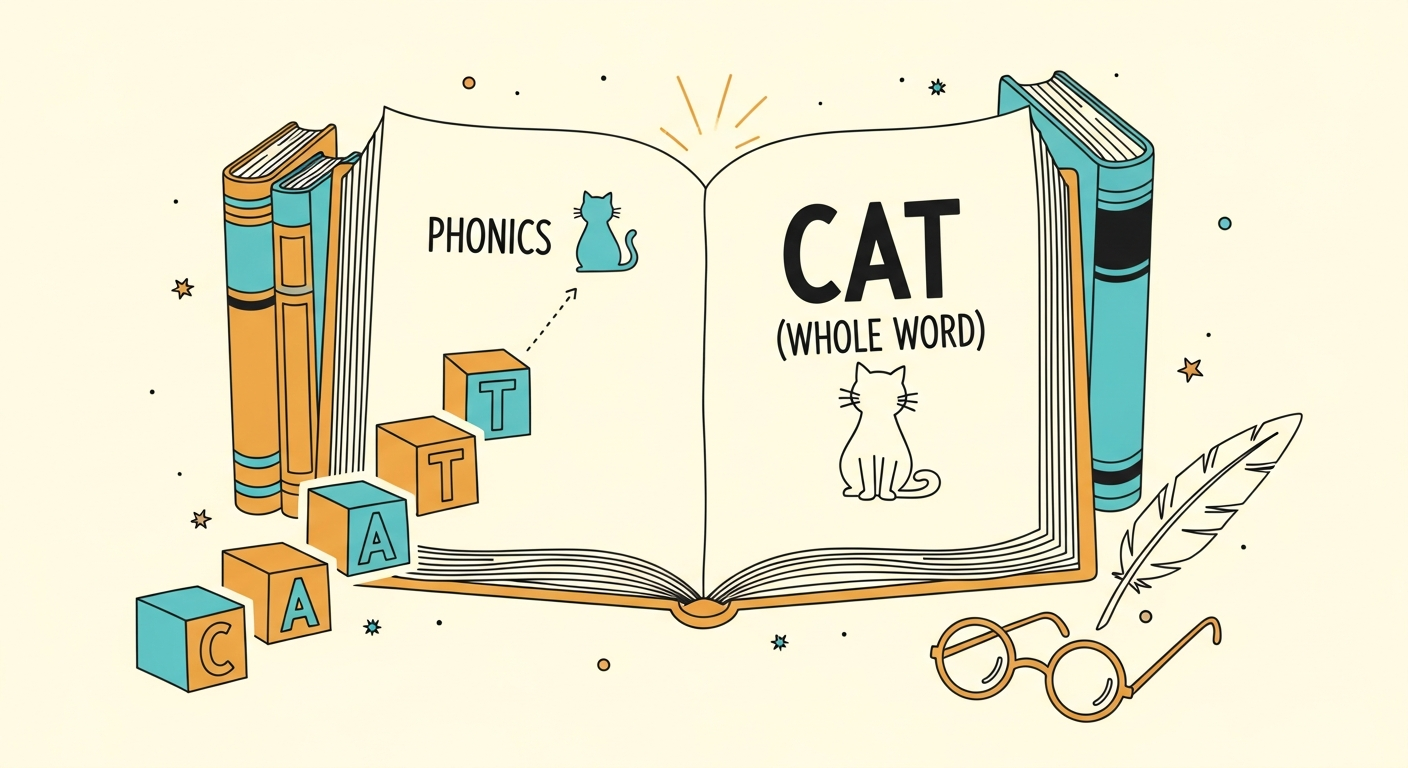
This is where the letters come in! Phonics teaches children the relationships between letters (graphemes) and the sounds they represent. It's about decoding words by sounding them out. For example, seeing the letters 'c-a-t' and knowing they make the /c/-/a/-/t/ sounds, which blend together to form "cat."
Phonics vs. Whole Word: This is often where the discussion heats up. A strong phonics approach emphasizes systematic, explicit instruction in letter-sound correspondences. The "whole word" (or sight word) approach, on the other hand, encourages children to recognize entire words by sight, often through memorization, without necessarily breaking them down into individual sounds. While sight words are important for reading fluency, research strongly supports a phonics-first approach for teaching children how to decode unfamiliar words. Without phonics, children can struggle when they encounter words they haven't memorized.
What you can do: Point out letters and their sounds as you read together. "Look, that's the letter 's,' and it makes the /s/ sound!" Practice sounding out simple words. Many early reader books are designed with phonics in mind, making it easy to reinforce these skills.
3. Fluency: Reading Smoothly and Expressively
Fluency is the ability to read text accurately, quickly, and with appropriate expression. It's not just about speed; it's about reading in a way that sounds natural, like speaking. When a child reads fluently, their brain isn't bogged down by decoding every single word, freeing up mental energy for comprehension.
What you can do: Encourage repeated readings of favorite stories. Reading the same book several times helps build confidence and speed. You can also model fluent reading by reading aloud to your child, showing them what expressive reading sounds like. Try echo reading, where you read a sentence and your child reads it back to you.
4. Vocabulary: Knowing What Words Mean
Even if a child can sound out every word on a page, the story won't make sense if they don't know what the words mean. A rich vocabulary is crucial for understanding what they read and for expressing their own ideas.
What you can do: Talk, talk, talk! Engage your child in conversations, explain new words they encounter in books or daily life, and encourage them to ask questions about words they don't know. Reading a wide variety of books, both fiction and non-fiction, also naturally expands vocabulary.
5. Comprehension: Understanding the Story
Ultimately, the goal of reading is to understand the message, the story, or the information presented. Comprehension is the ability to grasp the meaning of what is read, to make connections, and to think critically about the text.
What you can do: Ask open-ended questions before, during, and after reading. "What do you think will happen next?" "Why do you think the character did that?" "What was your favorite part and why?" Encourage your child to retell stories in their own words. This helps them organize their thoughts and demonstrate their understanding.
Bringing It All Together: Your Role in Early Literacy
Understanding the phonics vs. whole word discussion within the context of these five pillars helps you see that a balanced approach is often the most effective. While phonics provides the essential tools for decoding, phonemic awareness lays the groundwork, and fluency, vocabulary, and comprehension ensure that reading is a meaningful and enjoyable experience.
As a parent, you are your child's first and most important teacher. By engaging with these pillars in playful, supportive ways, you're not just teaching them to read; you're nurturing a lifelong love of stories. Whether you're sounding out words, discussing what happens next, or simply snuggling up with a beloved book, every moment you share is building their world.
What kind of stories spark your child's imagination and make them ask to read it again?
Build your own story universe — link in bio
Newsletter
A little more wonder, weekly.
Story ideas, parenting reads, and what we’re building next.
Like this? There's one more next week
Free weekly note on using stories to navigate the things parenting books skip.
No spam. Just story inspiration and new feature updates.
Written by
Founder, Inky
Building Inky — an AI storytelling studio for personalized, imaginative stories. Writing about raising readers and creativity.