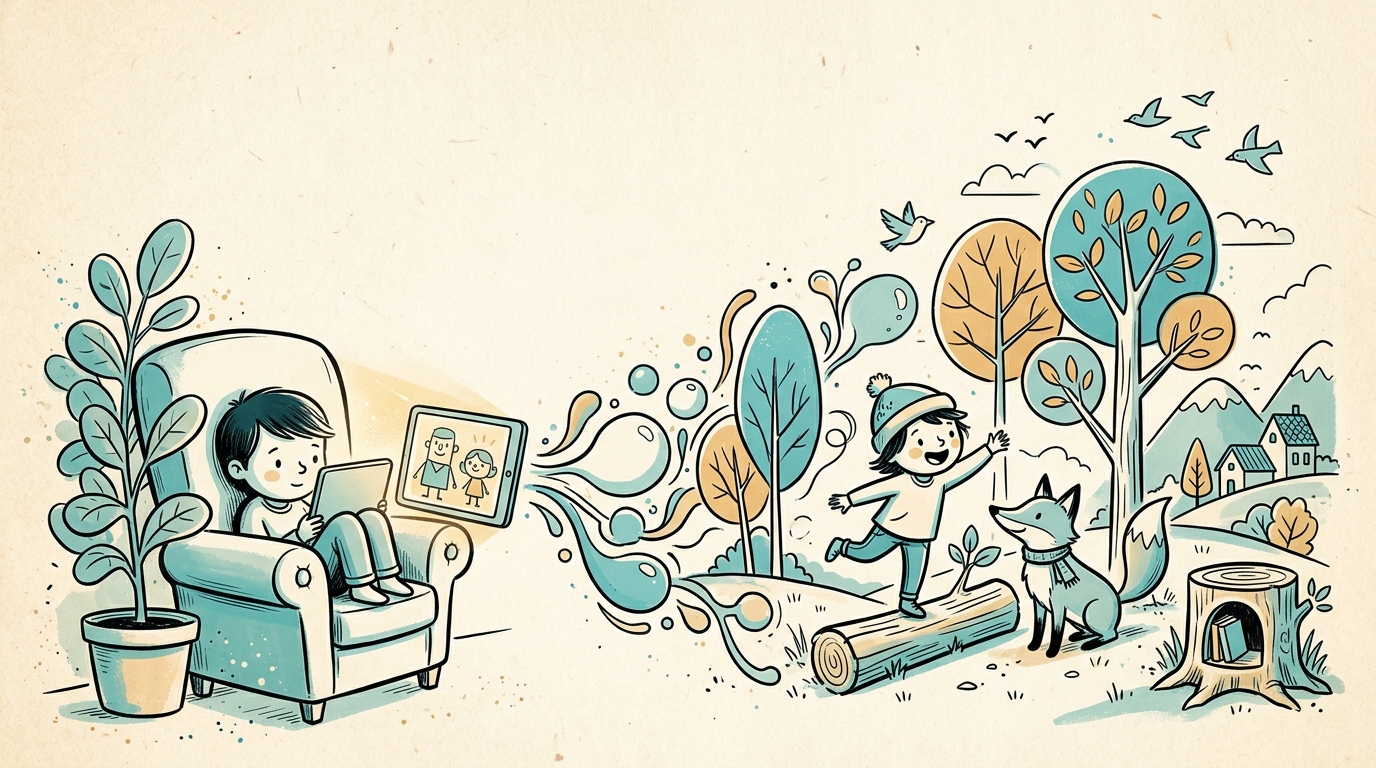
Dr. Rachel Barr at Georgetown University led a team that identified the "video deficit effect," where children under age three learn significantly less from a 2D screen than from a 3D person in the same room. This finding highlights a fundamental truth about development: the human brain is wired for interaction and depth, qualities that a flat, scrolling feed struggles to provide. When a child stares at a screen, they are often a passenger in someone else’s imagination. The challenge for parents and authors is not simply to remove the device, but to offer a destination that is more interesting than the glow of the glass.
Reducing time spent on devices is less about restriction and more about the redirection of creative energy. When the digital world is the only place where a child sees vibrant colors or hears complex stories, the physical world can feel dull by comparison. The goal is to bridge that gap by showing them that the world they inhabit is something they can influence, narrate, and expand.
The Narrative Bridge
One of the primary friction points with screens occurs during the transition away from them. Abruptly ending a session often triggers a cortisol spike because the brain’s reward system is suddenly deprived of a high-frequency stimulus. A more effective tactic is the use of narrative closure. Instead of "five more minutes," which is an abstract concept to a young child, try "one more scene" or "finish this chapter."
This approach treats the digital experience as a story with a logical conclusion rather than a stream of data to be severed. When the story ends, the child has reached a mental resting point. From there, the transition to a physical activity becomes a continuation of the narrative. If they were watching a show about space, the next activity could be drawing a map of a new planet. By carrying the theme from the screen into the room, the device becomes a starting point for play rather than its only location.
The Role of Productive Boredom
In a study of 400 children, researchers found that those who were allowed periods of unstructured "boredom" eventually developed more sophisticated internal play patterns. Constant digital stimulation removes the need for a child to invent their own entertainment. When the screen goes dark, the initial restlessness is actually the sound of the creative gears beginning to turn.
To support this, a physical environment should be "world-ready." This doesn't require expensive toys; it requires materials that allow for open-ended building. A box of loose parts—string, cardboard, clay, or old fabric—allows a child to externalize their thoughts. When a child realizes they can build a world of their own, the allure of a pre-made digital world begins to fade. They move from being a consumer of a world built by a corporation to the architect of a world built by their own hands.
Co-Creation Over Consumption
Screen time is often a solitary experience, even when others are in the room. To break the spell of the "zombie stare," the digital tool must be turned into a collaborative one. This is the difference between watching a video and building a story together. When parents and children use technology to create something—whether it is a digital drawing, a recorded song, or a written world—the screen serves as a canvas.
Inky provides a space where this kind of co-creation happens naturally, moving the focus from the act of looking to the act of building. By using a tool to illustrate a story or narrate a character's journey, the child is practicing literacy, logic, and empathy. The screen is no longer a barrier between the child and the world; it is a magnifying glass for their own ideas. This shift in posture changes the physiological response to the device, as the brain is actively solving problems rather than passively receiving images.
The Power of the Physical Artifact
One reason digital media is so addictive is its infinite nature; there is always another video, another level, or another post. Physical stories have a beginning, a middle, and an end. They have weight and texture. Bringing a digital creation into the physical world provides a sense of permanence that a screen cannot replicate.
Printing a story that a child has written or building a physical model of a character they imagined creates a "canon" for their life. It validates their imagination as something real and worthy of space on a bookshelf. When a child can hold the result of their creative time in their hands, they see the value of the effort they put in. They begin to understand that the most exciting stories aren't the ones they find on an app, but the ones they grow themselves.
A child who knows they can build a world of their own is less likely to spend their afternoon watching someone else inhabit theirs.
Newsletter
A little more wonder, weekly.
Story ideas, parenting reads, and what we’re building next.
Like this? There's one more next week
Free weekly note on using stories to navigate the things parenting books skip.
No spam. Just story inspiration and new feature updates.
Written by
Founder, Inky
Building Inky — an AI storytelling studio for personalized, imaginative stories. Writing about raising readers and creativity.