Contents
- The Fundamental Difference: Active vs. Passive
- YouTube: Passive Consumption
- Interactive Stories: Active Creation
- The Neuroscience
- The Attention Span Factor
- YouTube's Infinite Scroll Problem
- Stories Have Clear Endpoints
- Language Development Comparison
- The Bridge Strategy
- Implementation: The Gradual Swap
- Week 1: One Session
- Week 2: Choice Between Formats
- Week 3: Creation First
- What Parents Report
- Conclusion
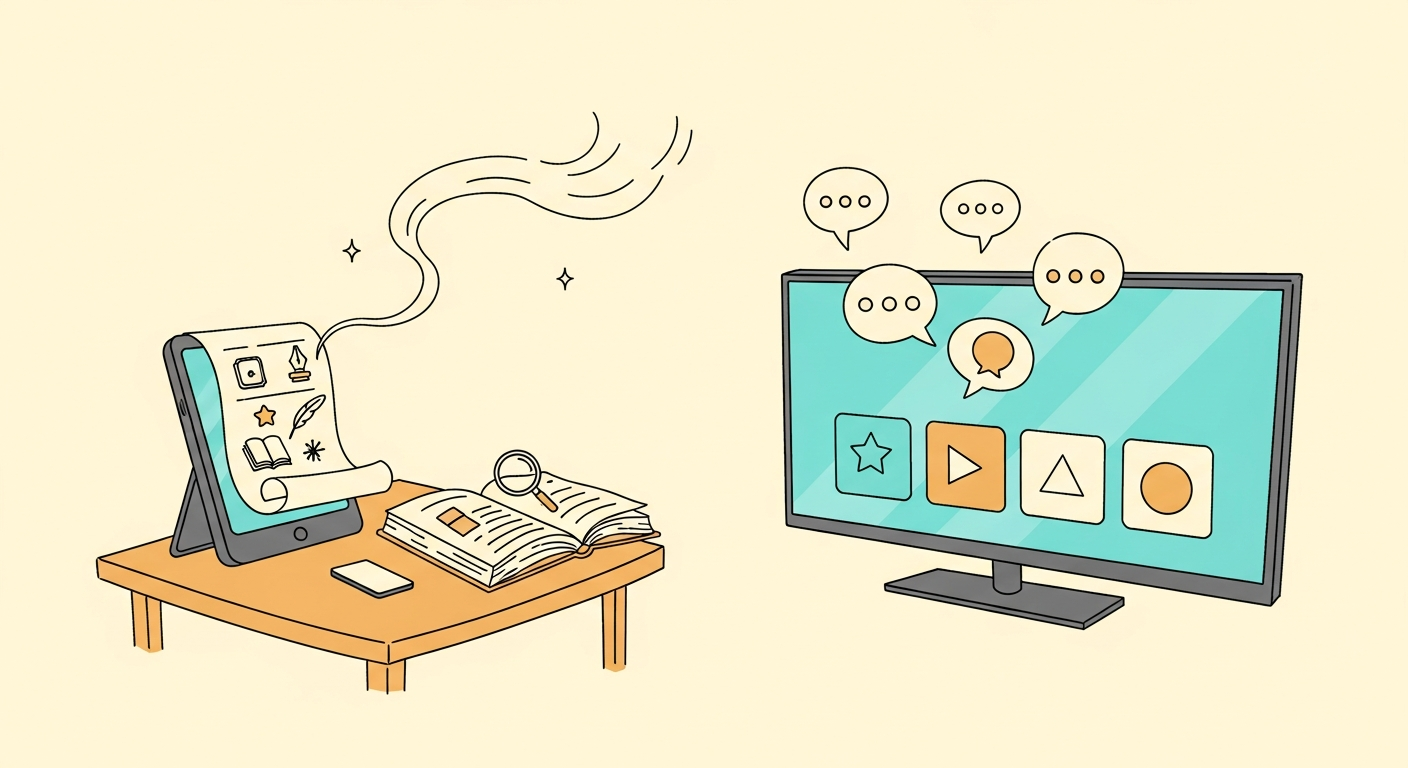
Your child wants screen time. You can give them YouTube videos or interactive stories. Both involve screens, but neurologically and developmentally, they're completely different experiences.
Understanding these differences helps parents choose tools that build skills instead of just passing time.
The Fundamental Difference: Active vs. Passive
YouTube: Passive Consumption
Child's brain: watches, processes visuals, listens. Minimal cognitive engagement. Imagination centers remain inactive (visuals are provided). No choices affect outcomes. Infinite scroll hijacks attention spans.
Skill development: Minimal. Primary outcome is entertainment and time-passing.
Interactive Stories: Active Creation
Child's brain: imagines scenes, predicts outcomes, makes choices affecting plots, engages language centers (reading/listening), creates mental imagery from text.
Skill development: Reading comprehension, vocabulary, imagination, decision-making, narrative understanding.
The Neuroscience
fMRI studies from MIT show distinct brain activation patterns: YouTube viewing activates primarily visual cortex and basic attention networks - 3-5 brain regions. Story reading/listening activates: visual imagination areas, language processing, emotional centers, memory formation, predictive networks - 12-15 regions.
More brain regions activated = more learning, stronger memory formation, better skill development.
The Attention Span Factor
YouTube's Infinite Scroll Problem
Auto-play removes natural stopping points. Algorithm serves increasingly stimulating content. Result: kids develop tolerance for constant novelty and struggle with sustained focus on single topics.
Research shows kids who primarily consume algorithm-driven content show 41% worse sustained attention compared to peers with bounded screen time.
Stories Have Clear Endpoints
Every story ends. This trains kids: things have beginnings, middles, ends. Satisfaction comes from completion, not endless consumption. This builds patience and goal-orientation.
Language Development Comparison
Vocabulary exposure research: Traditional books: 2,000+ unique words per hour. Interactive digital stories: 1,800+ unique words per hour. Educational YouTube: 900 unique words per hour. Entertainment YouTube: 300 unique words per hour.
Story-based screen time exposes kids to 3-6x more vocabulary than video-based screen time.
The Bridge Strategy
If your child is addicted to YouTube topics (dinosaurs, space, trucks), DON'T fight the interest. Use it. "You love dinosaur videos? Let's create a dinosaur STORY where YOU discover a dinosaur egg. Want to make that?"
Channel their interests from passive consumption to active creation. Same topic, upgraded engagement.
Implementation: The Gradual Swap
Week 1: One Session
Replace one YouTube session with an interactive story on the same topic they love. If they resist: "We can do YouTube tomorrow. Today let's try this story where YOU'RE the space explorer."
Week 2: Choice Between Formats
"You can watch a dinosaur video OR create a dinosaur story. You choose." Many kids choose creation once they experience it.
Week 3: Creation First
"Create one story, then you can watch videos." Prioritize high-value screen time before allowing passive consumption.
What Parents Report
"We went from 3 hours of YouTube daily to 1 hour YouTube + 1 hour creating Inky stories. His vocabulary doubled in 3 months. His attention span improved. He prefers creating now - YouTube seems boring to him after being the hero." - Jennifer K., mom of 7-year-old
Conclusion
Digital stories are active; YouTube is passive. Both use screens, but only one builds skills. Choose interactive creation tools over infinite scroll algorithms.
Try Inky - interactive story creation that rivals YouTube for engagement while building reading skills. Make screen time educational. Get 2 free stories today!
Newsletter
A little more wonder, weekly.
Story ideas, parenting reads, and what we’re building next.
Like this? There's one more next week
Free weekly note on using stories to navigate the things parenting books skip.
No spam. Just story inspiration and new feature updates.
Written by
Founder, Inky
Building Inky — an AI storytelling studio for personalized, imaginative stories. Writing about raising readers and creativity.


